
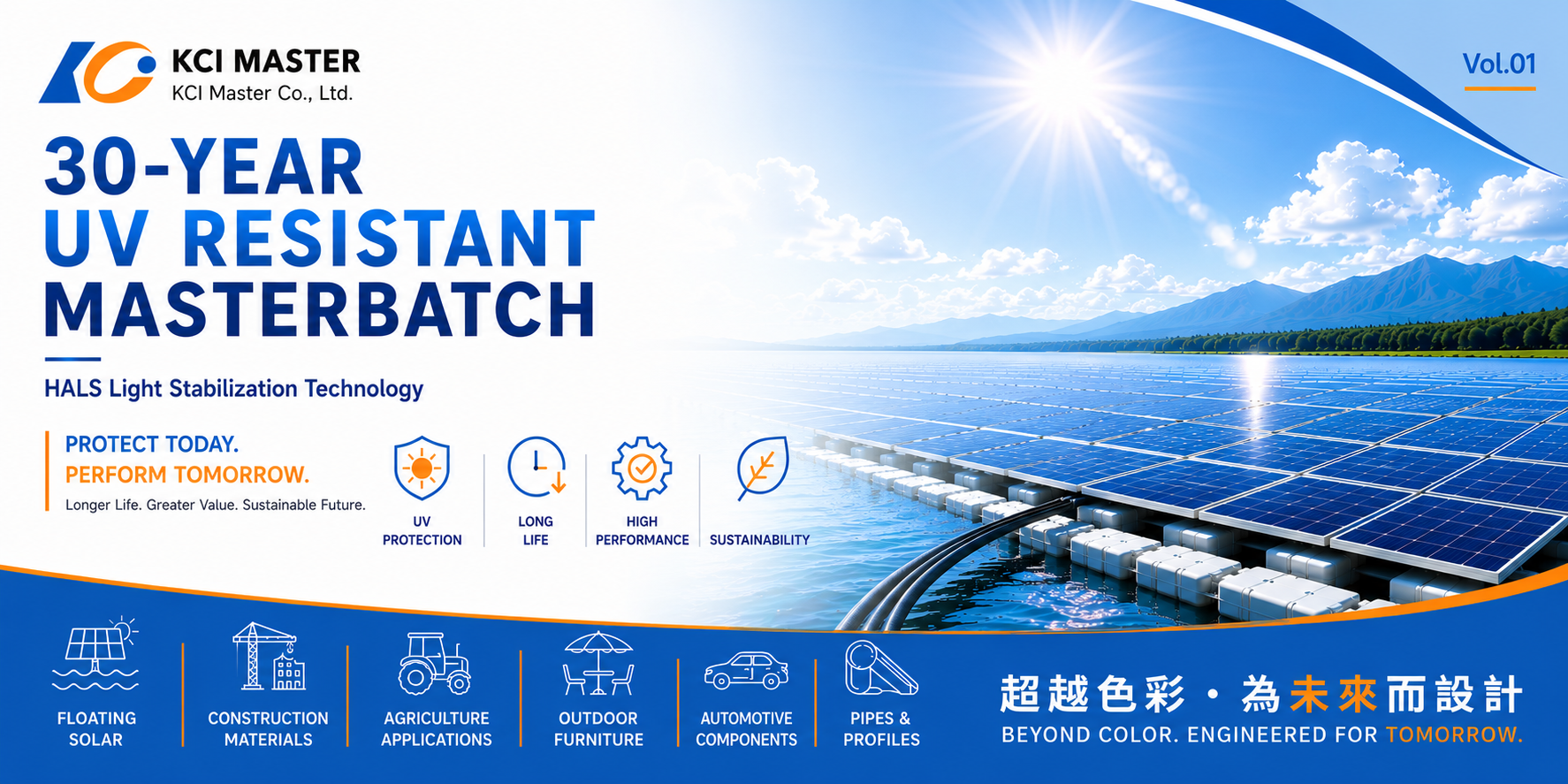
30-Year UV Resistant Masterbatch
Designing Longer Life for Outdoor Plastics
Executive Summary
Outdoor plastic products are continuously exposed to ultraviolet radiation, heat, humidity, oxygen, temperature fluctuations, and other environmental factors. Without proper weatherability design, polymers gradually lose their appearance, mechanical properties, and long-term reliability due to photo-oxidation.
This guide explains the fundamental principles of polymer weathering, how Hindered Amine Light Stabilizers (HALS) interrupt free-radical reactions, and how weatherability should be engineered according to different service-life expectations and outdoor environments.
Rather than focusing only on UV additives, long-term outdoor durability should be considered as a comprehensive engineering solution involving polymer selection, stabilization systems, processing conditions, product design, and expected service life.
What You’ll Learn
This technical guide provides practical engineering knowledge for designing long-life outdoor plastic products.
- Why plastics degrade under sunlight
- How HALS protects polymers
- How to design for 5-, 10-, 20-, and 30-year service life
- Weatherability considerations for different outdoor environments
- Typical applications of long-life UV resistant masterbatch
- How lifecycle thinking supports sustainable product design
Table of Contents
1. Why Do Plastics Degrade Outdoors?
2. How Does HALS Protect Plastics?
3. Designing Weatherability for 5-, 10-, 20-, and 30-Year Service Life
4. Weatherability Design for Different Outdoor Environments
5. Applications of Long-Life UV Resistant Masterbatch
6. KCI UV Solution
7. Beyond UV Resistance: Extending Product Lifetime as Part of Sustainability
8. Frequently Asked Questions
9. Glossary
10. References
Chapter 1
Why Do Plastics Degrade Outdoors?
Understanding UV Radiation, Free Radicals and Polymer Weathering
Many plastic products are designed for long-term outdoor use.
Examples include floating solar systems, agricultural equipment, construction materials, traffic facilities, outdoor furniture and marine infrastructure.
However, outdoor environments expose plastics to continuous ultraviolet (UV) radiation, oxygen, heat, moisture and temperature changes.
These environmental factors gradually accelerate polymer degradation and shorten product service life.
Unlike metals that primarily suffer from corrosion, plastics mainly experience photo-oxidative degradation.
This process begins when ultraviolet energy is absorbed by polymer molecules, triggering a chain reaction that slowly changes both the appearance and mechanical properties of the material.
Without an appropriate stabilization system, plastics may gradually lose gloss, discolor, chalk, crack, become brittle and eventually fail during service.
Understanding these degradation mechanisms is the foundation of weatherability engineering.
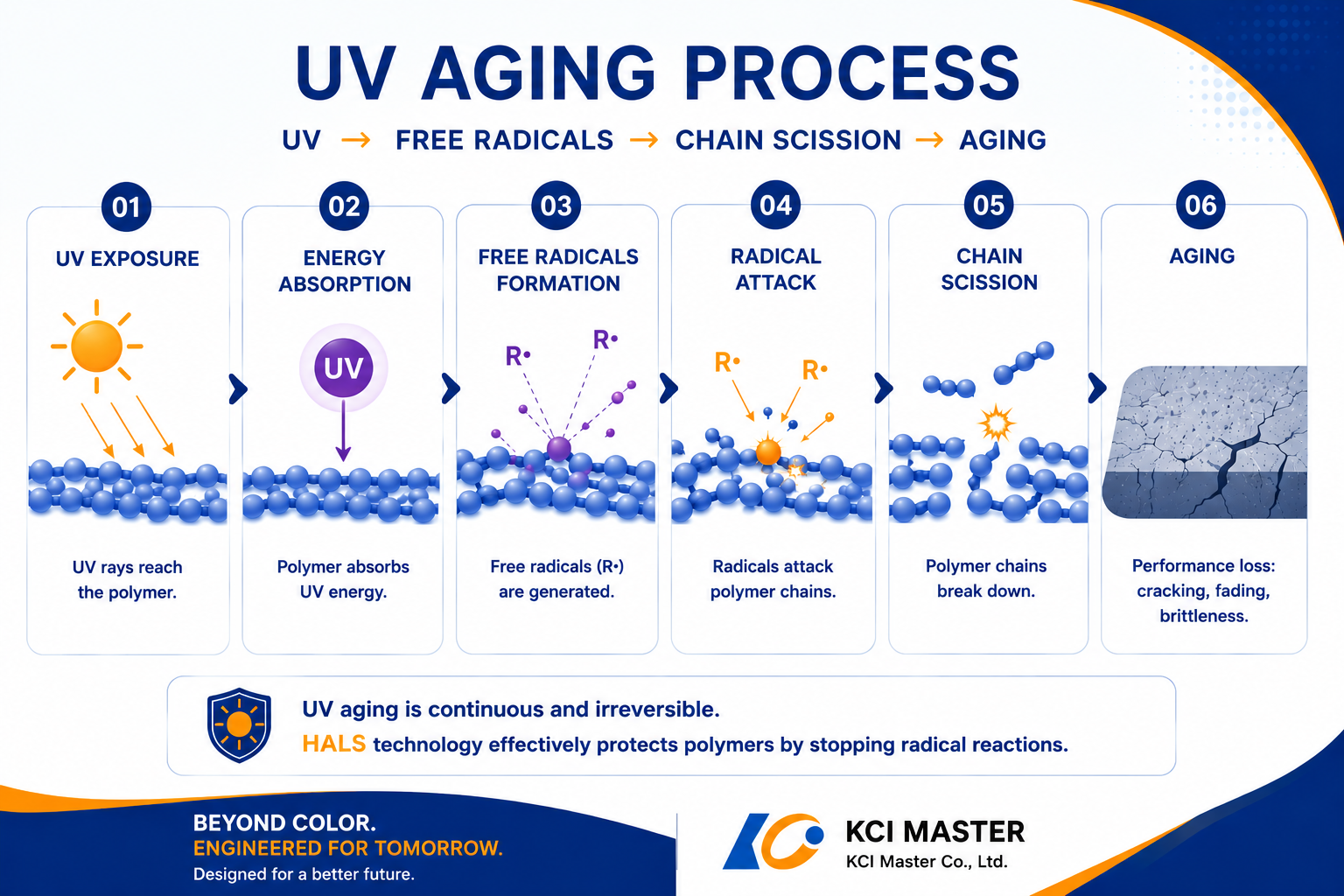
Why Does UV Radiation Cause Plastic Degradation?
Ultraviolet radiation carries sufficient energy to break chemical bonds within polymer chains.
When plastics absorb UV energy, unstable molecular fragments known as free radicals are generated.
These highly reactive molecules initiate a continuous oxidation process called photo-oxidation.
As free radicals continue to react with oxygen and neighboring polymer chains, the molecular structure gradually deteriorates.
Over time, plastics lose flexibility, impact resistance and surface quality, eventually affecting both product appearance and structural performance.
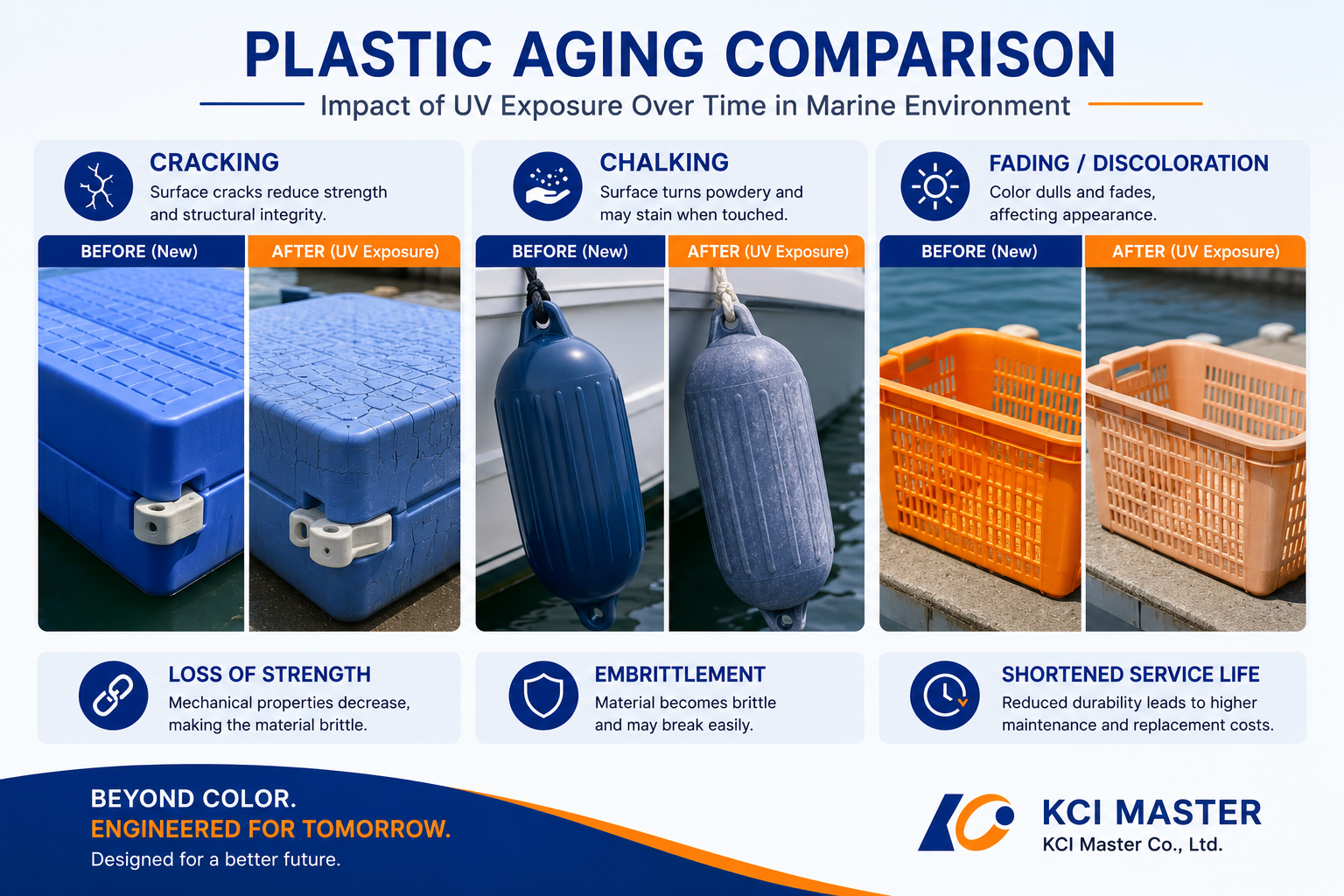
Typical Signs of Outdoor Weathering
| Weathering Effect | Description | Potential Impact |
|---|---|---|
| Color Fading | Pigment degradation caused by prolonged UV exposure. | Reduced product appearance and color consistency. |
| Surface Chalking | Polymer oxidation forms powder on the surface. | Loss of surface quality and weather resistance. |
| Cracking | Polymer chains break down after long-term UV exposure. | Reduced durability and structural integrity. |
| Embrittlement | Loss of flexibility due to molecular degradation. | Higher risk of impact failure. |
⚙ Engineering Notes
Outdoor weatherability is influenced by multiple factors, including polymer type, UV intensity, temperature, humidity, product geometry, wall thickness and service conditions.
Therefore, weatherability should be engineered as a complete material system rather than relying on a single additive.
💡 Key Takeaways
Plastic weathering is primarily caused by photo-oxidation initiated by ultraviolet radiation.
Understanding how free radicals degrade polymer chains provides the engineering foundation for selecting appropriate stabilization systems and designing products for long-term outdoor performance.
Chapter 2
How Does HALS Protect Plastics?
Understanding HALS, UV Absorbers and Modern Light Stabilization Systems
Once ultraviolet radiation initiates photo-oxidation, a large number of highly reactive free radicals are continuously generated inside the polymer.
Rather than blocking sunlight directly, modern stabilization systems focus on interrupting this degradation process before it spreads throughout the material.
Among today’s light stabilization technologies, Hindered Amine Light Stabilizers (HALS) are widely recognized for their outstanding long-term protection against polymer degradation.
They are commonly used in outdoor plastics, construction materials, agricultural products, automotive components and many other applications requiring extended weatherability.
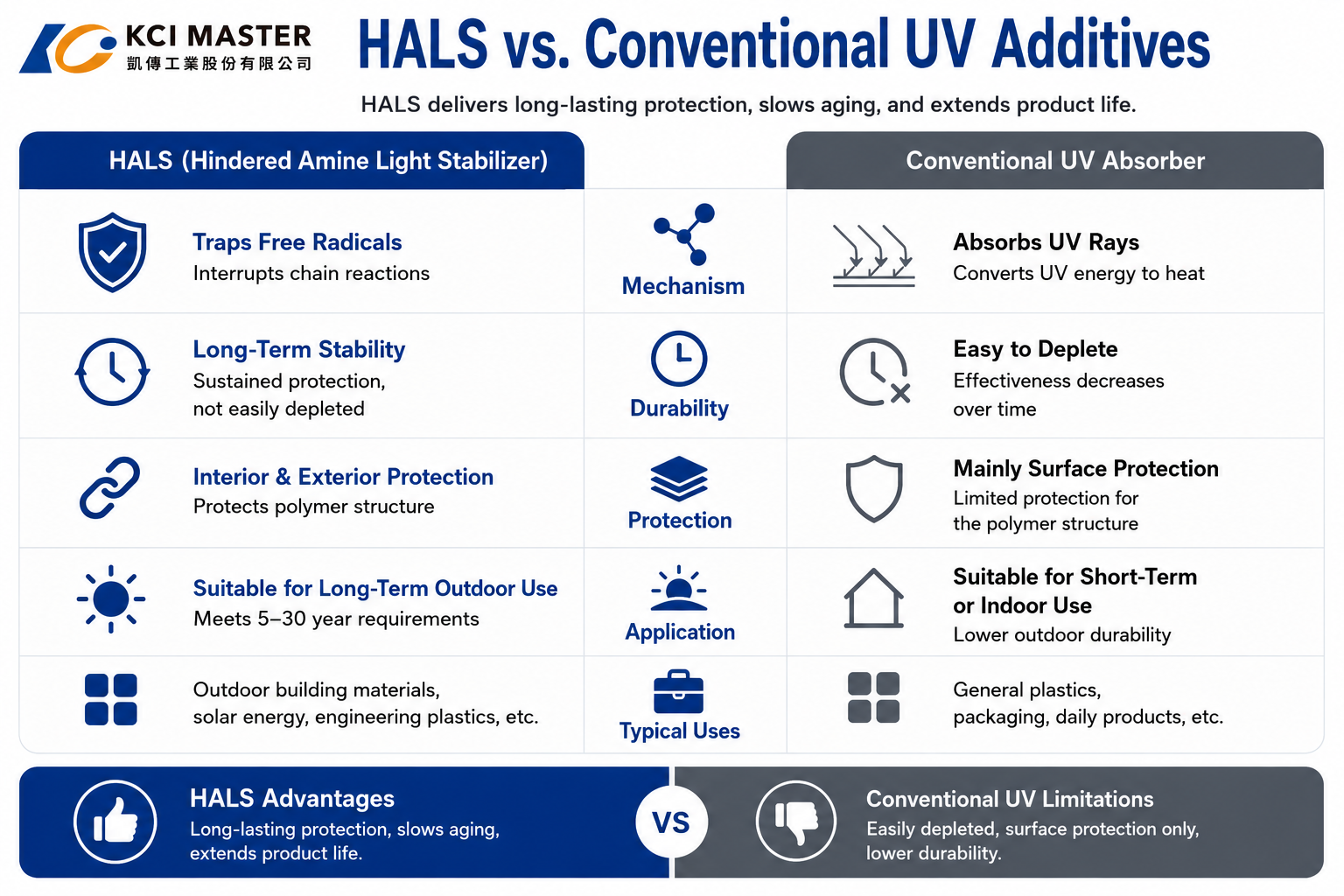
Unlike UV absorbers, HALS primarily function by scavenging free radicals generated during photo-oxidation.
This mechanism slows down the degradation chain reaction and helps preserve the mechanical properties, appearance and long-term durability of plastic products.
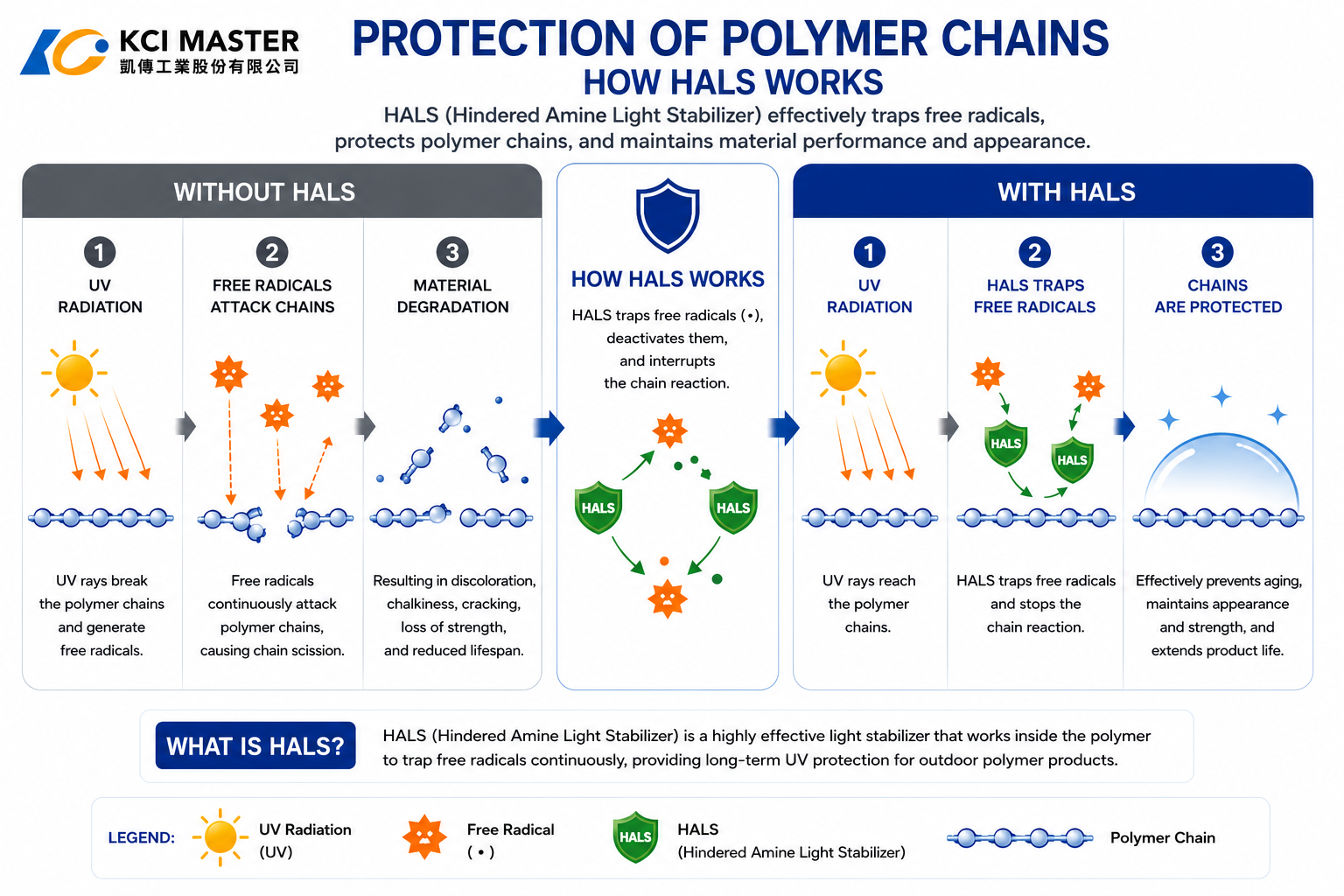
HALS vs. UV Absorbers
Although HALS and UV absorbers are both classified as light stabilizers, they protect polymers through different mechanisms and are often used together rather than as alternatives.
| Technology | Primary Function | Typical Role |
|---|---|---|
| HALS | Scavenges free radicals generated during photo-oxidation. | Maintains long-term polymer stability and durability. |
| UV Absorber | Absorbs ultraviolet energy before it damages polymer chains. | Reduces the initial impact of UV radiation. |
Why Are HALS and UV Absorbers Often Used Together?
High-performance outdoor formulations frequently combine HALS and UV absorbers because they protect polymers at different stages of the degradation process.
UV absorbers reduce the amount of ultraviolet energy entering the polymer, while HALS suppress the free-radical reactions that continue after UV exposure.
By combining these complementary stabilization mechanisms, formulators can significantly improve long-term weatherability for demanding outdoor applications.
⚙ Engineering Notes
HALS are not suitable for every polymer system.
In many high-weatherability formulations, HALS and UV absorbers complement each other rather than replace one another.
The optimal stabilization package should always be selected according to the polymer type, processing conditions, service environment and expected product lifetime.
💡 Key Takeaways
HALS do not simply block ultraviolet radiation.
Instead, they interrupt the free-radical reactions responsible for polymer degradation.
When combined with UV absorbers and an appropriate material formulation, they help extend outdoor durability and improve long-term weatherability.
Chapter 3
Designing Weatherability for Long-Term Service Life
Selecting the Appropriate Weatherability Target for Outdoor Applications
Not every outdoor plastic product requires the same level of weatherability.
The appropriate stabilization strategy should always be determined according to the intended application, service environment and expected product lifetime.
For example, a temporary construction cover may only require several years of outdoor durability, while floating solar systems, infrastructure components or outdoor building materials may be expected to remain in service for decades.
Rather than asking, “How much UV stabilizer should be added?”, engineers should first ask:
“How long is this product expected to perform outdoors?”
Typical Service-Life Targets
| Target Service Life | Typical Applications | Design Considerations |
|---|---|---|
| 5 Years | Temporary outdoor products | Basic UV protection |
| 10 Years | Agricultural products, outdoor equipment | Enhanced weatherability |
| 20 Years | Building materials, infrastructure | Long-term weatherability design |
| 30 Years | Floating solar, marine infrastructure, long-life outdoor systems | Comprehensive stabilization strategy |
Common Misconceptions
Weatherability is often misunderstood as simply adding more UV stabilizer.
In reality, long-term outdoor performance depends on a combination of material selection, stabilization systems, product geometry, processing conditions and environmental exposure.
Increasing additive loading alone does not guarantee longer service life.
Effective weatherability design requires balancing performance, reliability and application requirements.
✔ Design Tips
- Define the expected service life before selecting a stabilization system.
- Consider the actual outdoor environment instead of UV intensity alone.
- Evaluate polymer type, product geometry and processing conditions together.
- Verify long-term performance through appropriate laboratory and field testing.
💡 Key Takeaways
There is no universal weatherability specification suitable for every outdoor plastic product.
An effective weatherability design should be based on the intended application, environmental conditions and expected service life rather than relying on a single additive or formulation.
Chapter 4
Weatherability Design for Different Outdoor Environments
Outdoor environments create different weathering challenges for plastic materials.
Outdoor plastics are exposed to very different environmental conditions depending on where they are used.
A product designed for a tropical climate experiences different aging mechanisms than one installed in a desert, coastal area or high-altitude region.
Rather than applying the same stabilization package to every application, weatherability should be designed according to the actual service environment.
Understanding the environmental conditions helps engineers select appropriate materials and stabilization systems for long-term performance.
Typical Outdoor Environments
| Environment | Primary Conditions | Weatherability Considerations |
|---|---|---|
| Tropical | High UV, high temperature and high humidity | Improve light stabilization while considering heat and moisture exposure. |
| Desert | Intense UV, high temperature and dry conditions | Strengthen UV stabilization and consider heat stabilization where required. |
| Coastal | High UV, humidity and salt spray | Evaluate humidity and salt spray together when designing the stabilization system. |
| High Altitude | Strong UV radiation and large temperature fluctuations | Increase UV protection to accommodate higher solar radiation. |
⚙ Engineering Notes
Weatherability is influenced by more than ultraviolet radiation alone.
Temperature, humidity, salt spray, oxygen, pollutants and product geometry all contribute to long-term outdoor performance.
A successful stabilization strategy should therefore be developed as part of a complete engineering design rather than relying on a single additive.
✔ Design Tips
- Identify the actual installation location before selecting a stabilization package.
- Consider climate conditions together with polymer type and product geometry.
- Select materials according to the expected service environment rather than laboratory conditions alone.
- Confirm long-term performance through appropriate weathering tests whenever possible.
💡 Key Takeaways
Different outdoor environments create different weathering conditions.
Effective weatherability design should always be based on the actual service environment rather than applying the same stabilization approach to every product.
Chapter 5
Applications of Long-Life UV Resistant Masterbatch
Outdoor Applications That Require Long-Term Weatherability
Different outdoor products require different levels of weatherability.
A short-term plastic product and an engineering component designed for decades of outdoor use should not rely on the same stabilization strategy.
Long-life UV resistant masterbatch is especially relevant when products are continuously exposed to sunlight, heat, moisture, temperature changes or other demanding environmental conditions.
Floating Solar Systems
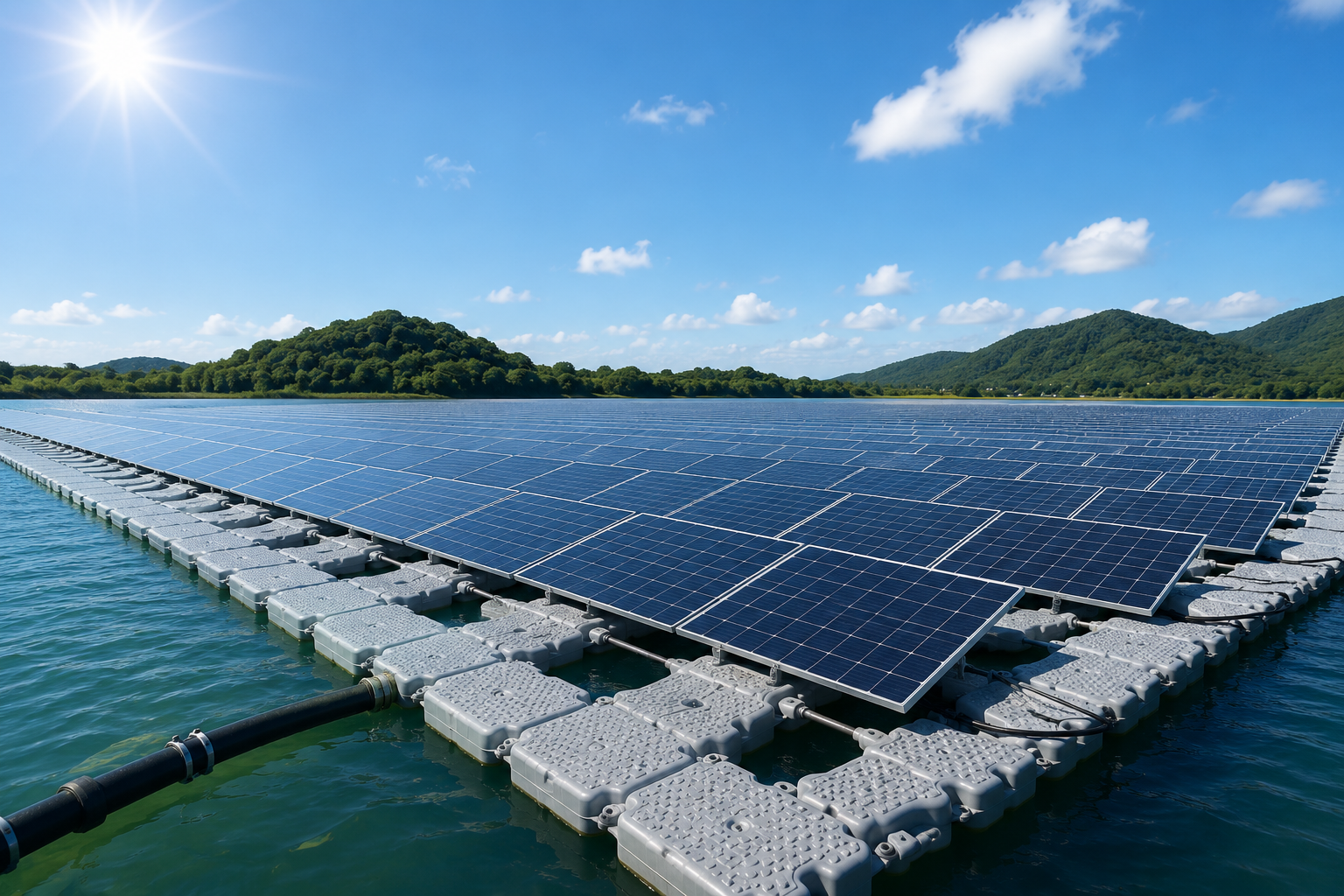
Floating solar systems are installed on reservoirs, lakes and other water surfaces where plastic floats remain exposed to continuous UV radiation, heat, humidity and temperature fluctuations.
Weatherability design is therefore important for maintaining material performance and long-term system reliability.
Marine and Waterfront Applications
Plastics used in marine, coastal and waterfront environments may face combined exposure to UV radiation, high humidity and salt spray conditions.
These environmental factors should be evaluated as part of the complete material and product design.
Construction Materials
Exterior profiles, pipes, panels and other outdoor construction products often require stable appearance, dimensional stability and long-term mechanical performance.
Agricultural Applications
Agricultural plastics are frequently exposed to strong sunlight, high temperatures and seasonal climate changes.
Appropriate weatherability design helps support reliable performance throughout the intended service period.
Outdoor Furniture and Public Facilities
Outdoor furniture, playground equipment and public infrastructure require both appearance retention and dependable mechanical performance during long-term outdoor exposure.
Key Takeaways
Different applications require different weatherability targets.
Product lifetime, material type, environmental exposure and structural requirements should be evaluated together before selecting a UV stabilization solution.
Chapter 6
KCI UV Solution
Designing Weatherability for Long-Term Outdoor Performance
Every outdoor plastic application has different performance requirements.
Selecting a UV stabilization system should therefore begin with understanding how and where the product will be used, rather than simply choosing an additive package.
At KCI, weatherability is approached as a complete engineering solution.
Material selection, stabilization systems, processing conditions and expected service life are evaluated together to help customers develop products with reliable long-term outdoor performance.
Rather than applying a standard formulation to every application, each solution is developed according to the actual product requirements and environmental conditions.
Weatherability Design Process
| Step | Engineering Consideration |
|---|---|
| 01 | Define the application and expected service life. |
| 02 | Evaluate the outdoor environment and climate conditions. |
| 03 | Select the appropriate polymer and stabilization system. |
| 04 | Verify performance through laboratory and application testing. |
⚙ Engineering Notes
Long-term weatherability cannot be determined by additive loading alone.
Polymer selection, product geometry, wall thickness, processing conditions and environmental exposure all influence outdoor durability and should be considered together during product development.
Design Philosophy
- Design for the intended service environment.
- Engineer for long-term reliability rather than short-term performance.
- Evaluate the complete stabilization system instead of individual additives.
- Optimize product lifetime through comprehensive weatherability engineering.
💡 Key Takeaways
Effective UV stabilization begins with understanding the application rather than selecting an additive.
By integrating polymer selection, stabilization systems and engineering design, long-term outdoor performance can be planned more systematically and reliably.
Chapter 7
Beyond UV Resistance
Extending Product Lifetime Through Better Material Design
Weatherability is more than protecting plastics from ultraviolet radiation.
It is about designing products that remain reliable throughout their intended service life.
For many outdoor applications, replacing products requires additional materials, transportation, installation, maintenance and waste management.
Improving durability can therefore reduce replacement frequency and support more efficient use of resources throughout the product lifecycle.
Rather than focusing only on material performance today, engineers are increasingly designing products to deliver long-term reliability and lifecycle value.
KCI Perspective
Sustainability is not defined by a single material or technology.
In many applications, extending product lifetime can be just as important as reducing the environmental impact of manufacturing.
A product designed to perform reliably for decades may reduce the need for frequent replacement, additional manufacturing, transportation and maintenance.
Although the overall environmental benefit depends on the specific application and should be evaluated through Life Cycle Assessment (LCA), durability remains an important consideration in sustainable product design.
Design Thinking
- Think beyond manufacturing and consider the entire product lifecycle.
- Design for long-term reliability instead of short-term performance.
- Reduce future maintenance and replacement whenever practical.
- Create long-term value through thoughtful material engineering.
⚙ Engineering Notes
Extending product lifetime does not automatically mean a lower carbon footprint.
The overall environmental impact depends on material selection, manufacturing, transportation, maintenance, service life and end-of-life management.
Where environmental claims are made, they should be supported by appropriate Life Cycle Assessment (LCA) or other recognized evaluation methods.
💡 Key Takeaways
Long-term weatherability is not only about protecting plastics from UV degradation.
It is also about improving reliability, extending product lifetime and supporting more sustainable engineering through lifecycle thinking.
Longer Product Life Creates Greater Value.
Designing for durability is not simply about extending service life.
It is about creating products that deliver lasting performance, greater reliability and better lifecycle value.
Frequently Asked Questions
1. Does HALS completely prevent plastic aging?
No. HALS significantly slows photo-oxidative degradation by scavenging free radicals, but no stabilization system can completely stop polymer aging.
2. Can HALS replace UV absorbers?
Not necessarily. HALS and UV absorbers protect polymers through different mechanisms and are often used together in high-weatherability formulations.
3. Does more HALS always provide longer service life?
No. Long-term durability depends on the complete formulation, polymer selection, processing conditions, product geometry and service environment.
4. Does a 30-year design target guarantee a 30-year service life?
No. Target service life is an engineering objective. Actual performance depends on application conditions and should be verified through laboratory and field testing.
5. Why are outdoor weathering tests necessary?
Accelerated weathering and outdoor exposure tests help evaluate long-term material performance before commercial use.
6. Is weatherability influenced only by UV radiation?
No. Temperature, humidity, oxygen, pollutants, salt spray and product design all contribute to long-term weatherability.
7. Does longer product lifetime automatically reduce carbon footprint?
Not necessarily. Longer service life may reduce replacement frequency and resource consumption, but environmental benefits should be evaluated through Life Cycle Assessment (LCA).
8. How should a UV stabilization system be selected?
Selection should be based on polymer type, expected service life, outdoor environment, processing conditions and application requirements rather than additive loading alone.
Glossary
| HALS | Hindered Amine Light Stabilizer that scavenges free radicals generated during photo-oxidation. |
| UV Absorber | An additive that absorbs ultraviolet radiation before it damages polymer chains. |
| Photo-Oxidation | Polymer degradation initiated by ultraviolet radiation and oxygen. |
| Free Radical | A highly reactive molecule responsible for chain degradation reactions. |
| Weatherability | The ability of a material to maintain performance during outdoor exposure. |
| Service Life | The expected period during which a product performs its intended function. |
| Life Cycle Assessment (LCA) | A standardized methodology for evaluating environmental impacts throughout a product’s lifecycle. |
References
- BASF Plastic Additives – Tinuvin® Light Stabilizers
- BASF Plastic Additives – HALS and UV Absorbers
- ISO 4892 – Plastics — Methods of Exposure to Laboratory Light Sources
- ASTM G154 – Fluorescent UV Exposure Testing
- ASTM G155 – Xenon Arc Exposure Testing
- ISO 4582 – Determination of Changes in Colour and Mechanical Properties After Exposure
- Q-Lab Corporation – QUV Accelerated Weathering Tester
- ISO 14040 / ISO 14044 – Life Cycle Assessment
About This Guide
| Series | KCI Technical Guide Vol.01 |
|---|---|
| Topic | 30-Year UV Resistant Masterbatch |
| Publisher | KCI Master |
| Version | Version 2.0 |
| Publication | 2026 |
| Audience | Material Engineers, Product Designers, Manufacturers, Purchasing Professionals and Brand Owners. |
Technical Disclaimer
This guide provides general engineering information regarding polymer weatherability, light stabilization and outdoor durability. It does not guarantee specific product performance or service life.
Actual outdoor performance depends on polymer type, formulation, processing conditions, product geometry, installation environment and application conditions. Service-life targets should be verified through appropriate laboratory and field testing.
Statements regarding sustainability, lifecycle value or environmental performance should not be interpreted as carbon footprint claims unless supported by Life Cycle Assessment (LCA) or other recognized evaluation methodologies.