
Why the Same Color Masterbatch Cannot Be Used for Every Product: The Importance of Material Selection
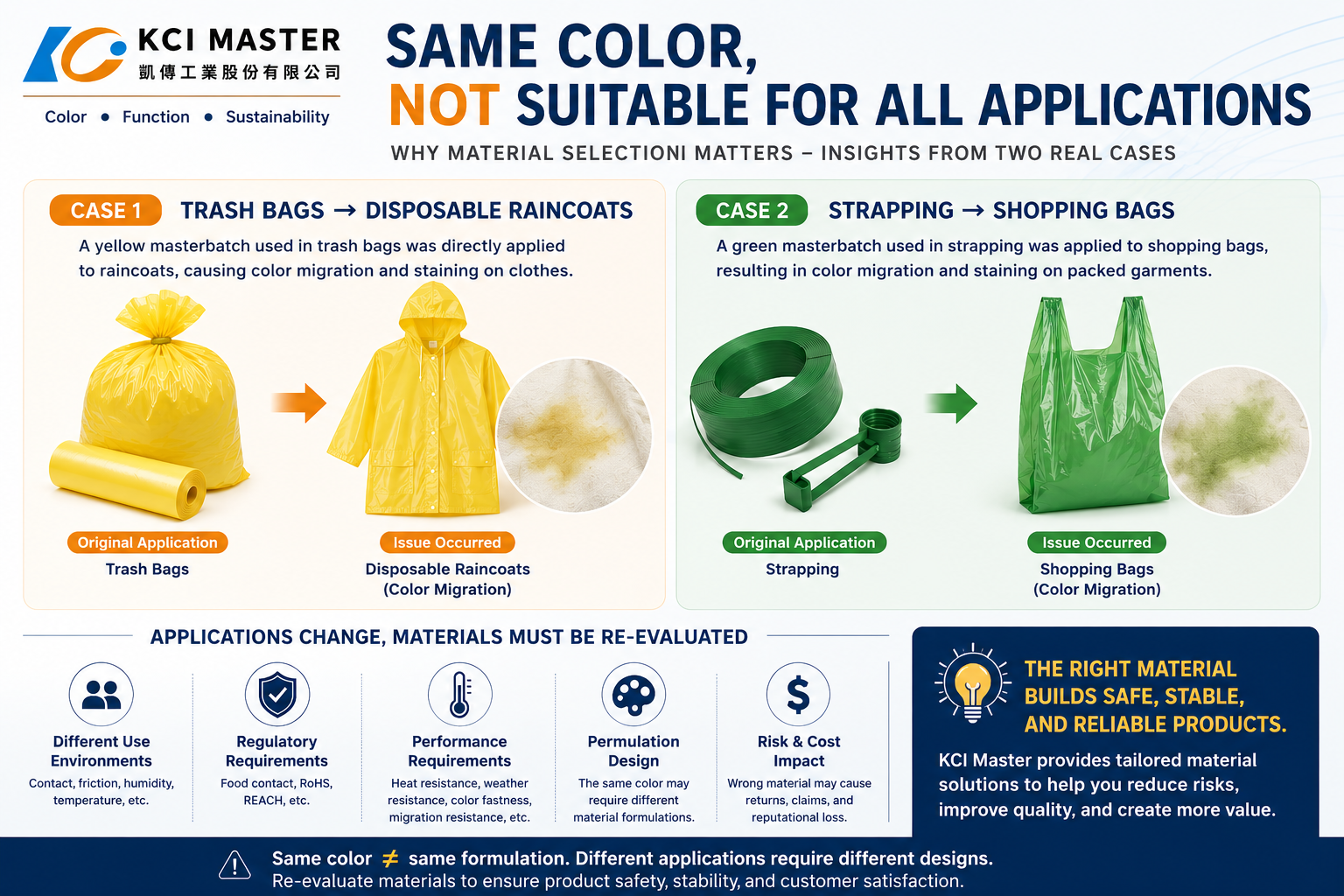
Why the Same Color Masterbatch Cannot Be Used for Every Product
Understanding Material Selection Through Two Real-World Cases
Many people assume that if a masterbatch has the same color, it can be used across different plastic products.
In plastic material development, however, the same color does not always mean the same specification, and the same specification does not always mean suitability for every application.
What truly affects product performance is not only color, but also application, processing conditions, contact environment, regulatory requirements, and end-use expectations.
Case 1: From Trash Bags to Disposable Raincoats
A customer originally used a yellow masterbatch for trash bag production.
For trash bags, the key requirements usually include basic appearance, stable processing, cost control, and suitability for the original application.
Later, the same yellow masterbatch was used for disposable raincoats without re-evaluating the material specification.
However, raincoats may come into contact with clothing and the human body. They may also be used under wet conditions, friction, and temperature changes.
As a result, color transfer occurred and stained clothing at the customer end.
The issue was not necessarily poor masterbatch quality. The real problem was that the material was used in an application it was not originally designed for.
Case 2: From Plastic Strapping to Shopping Bags
Another customer originally used a green masterbatch for plastic strapping.
Plastic strapping usually focuses on strength, toughness, processing stability, and cost efficiency.
Later, the same green masterbatch was applied to shopping bags that could come into contact with clothing or other goods.
Under long-term contact, stacking, friction, or temperature changes, color migration occurred and caused staining issues.
This case shows that even if the color looks the same, the material may not be suitable for a different product application.
Why Application Changes Require Material Re-Evaluation
Material engineers do not evaluate color alone. They also consider the actual application conditions of the product.
- Will the product contact the human body?
- Will it contact clothing or textiles?
- Will it contact food?
- Will it be used outdoors?
- Does it require heat, weather, or abrasion resistance?
- Does it need to comply with RoHS, REACH, or food-contact regulations?
- Is there a risk of color migration?
These conditions can directly affect pigment selection, additive design, testing requirements, and overall formulation.
What Is Color Migration?
Color migration refers to the transfer of color from one material to another due to friction, heat, moisture, pressure, or long-term contact.
In plastic products, common risks include:
- Plastic bags staining clothing
- Packaging materials staining products
- Raincoats or plastic films transferring color to contacted materials
- Color transfer after long-term stacking or storage
Color migration may not appear immediately after production. It can occur during transportation, storage, or actual use.
Quality Control Is Not Just Final Inspection
Many people think that once a product passes final inspection, it is safe and reliable.
In reality, quality is built throughout the entire process, not only checked at the end.
At KCI Master, our quality control process may include:
- Incoming Inspection
- First Article Inspection
- In-Process Inspection
- Final Inspection
- Batch Traceability and Retained Samples
The purpose is to reduce potential risks before products are delivered, instead of reacting only after a problem occurs at the customer end.
How KCI Master Helps Reduce Application Risks
At KCI Master, we do more than ask what color the customer needs.
Before formulation development, we also evaluate:
- Product application
- Base resin
- Processing method
- End-use environment
- Contact with people, clothing, food, or other materials
- Regulatory requirements
- Weather, heat, abrasion, or migration resistance needs
These factors directly influence formulation design.
A good material is not always suitable for every application. The right material for the right application is what truly matters.
FAQ
Q1: Can the same color masterbatch be used for different plastic products?
Not always. Different products may have different application environments, contact conditions, and regulatory requirements. Material suitability should be re-evaluated before use.
Q2: Why may a trash bag masterbatch not be suitable for disposable raincoats?
Disposable raincoats may contact clothing and the human body under wet and friction conditions, which can increase the risk of color migration.
Q3: Why may a strapping masterbatch not be suitable for shopping bags?
Plastic strapping focuses mainly on strength and cost, while shopping bags may contact clothing or consumer goods. Without proper evaluation, color transfer may occur.
Q4: What is color migration?
Color migration is the transfer of color from one material to another due to friction, heat, moisture, pressure, or material contact.
Q5: How can color masterbatch application risks be reduced?
Risks can be reduced by confirming product application, resin type, processing method, contact conditions, regulatory requirements, and quality control procedures during the development stage.
Recommended Reading
To learn more about masterbatch selection, color control, and plastic product quality, we also recommend:
- What Is Masterbatch? Types, Benefits, and Applications
- How to Choose the Right Color Masterbatch for Plastic Products
- What Is Functional Masterbatch? Applications and Selection Guide
Conclusion
In plastic product development, color is only one part of material selection.
What truly determines product stability and application suitability is whether the material matches the product’s real use conditions.
The same color does not always mean the same specification. When the application changes, the material should be re-evaluated.
Choosing the right material is the foundation of safe, stable, and reliable plastic products.
If you are developing a new plastic product or looking for a masterbatch solution for a specific application, KCI Master can help you evaluate material requirements and select the right solution for your product.