
What Is Anti-Static Masterbatch? Short-Term vs Long-Term Types, Principles and Selection Guide
What Is Anti-Static Masterbatch? Short-Term vs Long-Term Types, Principles, Applications and Selection Guide
A practical guide to migratory and polymer-type anti-static technologies for plastic products
Anti-static masterbatch is a functional additive system used in plastic processing to reduce the accumulation of static electricity on a product’s surface. It can help improve dust resistance, material handling, processing stability and electrostatic discharge control. Depending on the mechanism, anti-static solutions are commonly divided into short-term migratory types and long-term polymer-type systems. This guide explains how they work, where they are used and what should be considered during material selection.
Key Topics in This Guide
- Why plastics generate static electricity
- How anti-static masterbatch works
- Short-term migratory vs long-term polymer-type technologies
- Anti-static, ESD and conductive material concepts
- Performance testing, applications and selection criteria
Chapter 1 | Why Do Plastic Products Need Anti-Static Protection?
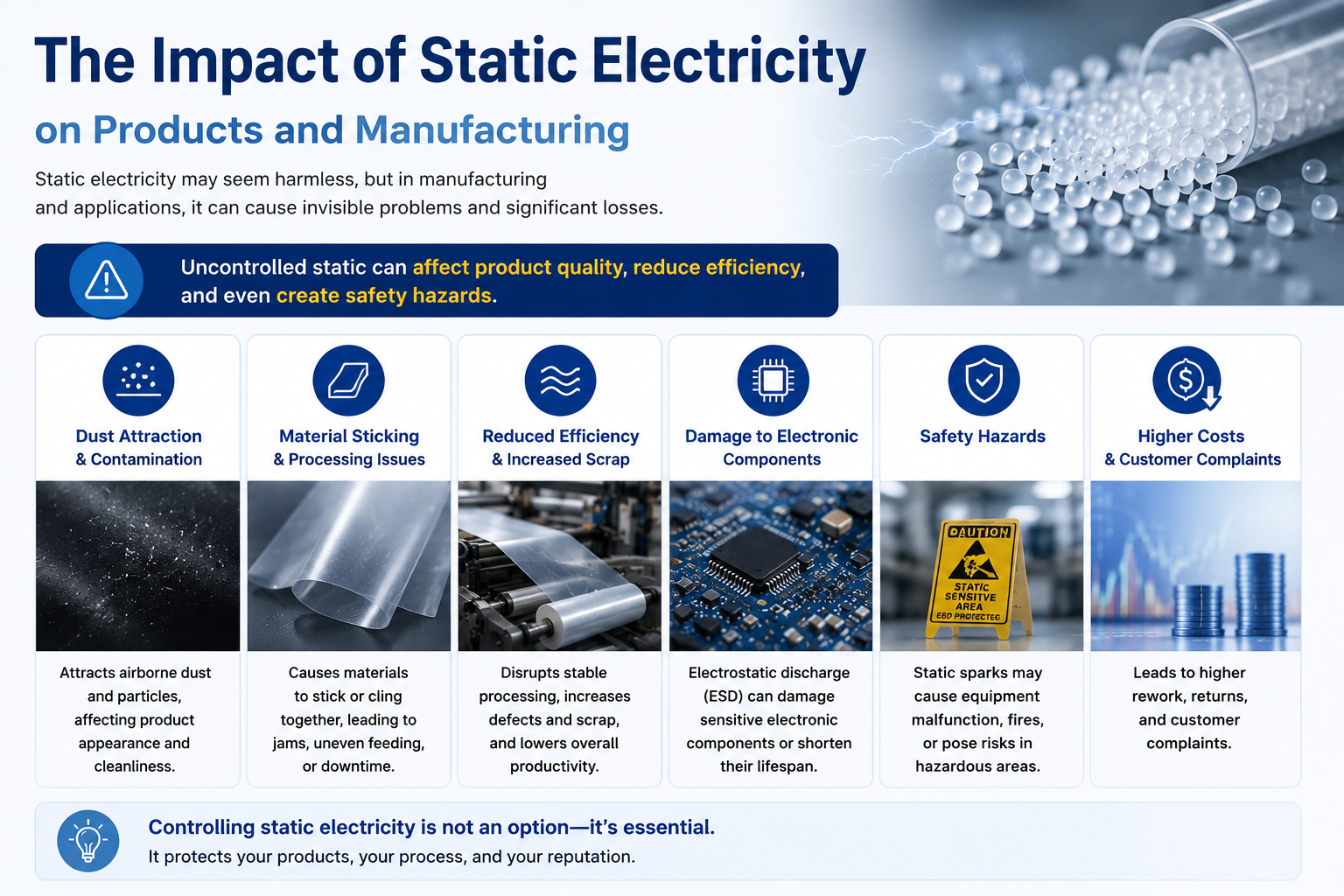
Static electricity is invisible, but its effects can appear throughout manufacturing, packaging, transportation and product use. For consumers, static may only be a minor inconvenience. In plastic processing, electronics and automated production, however, it can affect appearance, efficiency, reliability and safety.
Because most plastics are electrical insulators, charges generated by friction, contact or separation cannot easily dissipate.
- Dust and particles may be attracted to the product surface.
- Films, bags or molded parts may cling to one another.
- Static can interfere with feeding, conveying and automated handling.
- Electrostatic discharge may damage sensitive electronic components.
- In certain processes or hazardous environments, static discharge may create additional risks.
Chapter 2 | How Is Static Electricity Generated?
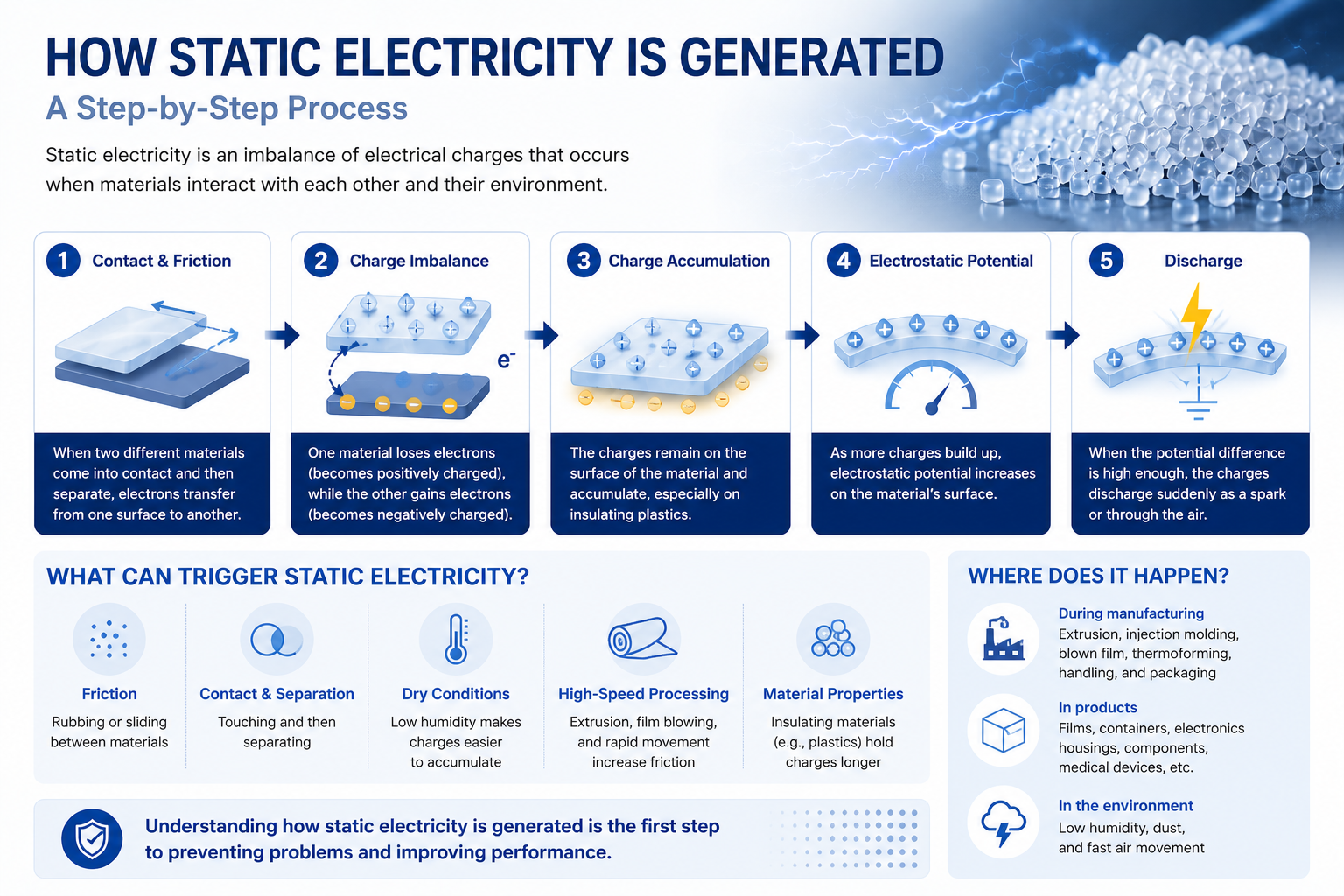
Static electricity is commonly created when two materials contact, rub against each other or separate. Electrons may transfer from one surface to another, causing one material to become positively charged and the other negatively charged. This is known as the triboelectric effect.
The process can be understood in three main stages:
1. Charge generation
Contact, friction and separation occur during extrusion, film handling, injection molding, packaging or conveying.
2. Charge accumulation
Because plastic has low conductivity, the generated charge remains on the material surface.
3. Electrostatic effects or discharge
Accumulated charge may cause dust attraction, material sticking, processing problems or sudden electrostatic discharge.
Chapter 3 | What Is Anti-Static Masterbatch?
Anti-static masterbatch is a type of functional masterbatch added to a base resin during plastic processing. It is designed to reduce the rate of static charge accumulation and help surface charges dissipate more easily.
Unlike a coating or post-treatment, the anti-static function is introduced during molding or extrusion. It can therefore be incorporated into existing film blowing, injection molding, sheet extrusion and other plastic processing operations.
Common application areas include packaging films, molded parts, electronic packaging, industrial containers, cleanroom products and automation components.
Chapter 4 | Main Types of Anti-Static Masterbatch
Anti-static technologies do not all use the same mechanism. The two most common categories are:
- Short-term migratory anti-static masterbatch
- Long-term polymer-type anti-static masterbatch
The difference is not simply which product is “better.” Each system is designed for different product lifetimes, environmental conditions, processing requirements and performance targets.
No Single Technology Fits Every Product
Disposable packaging, reusable logistics containers, electronic components and cleanroom equipment have very different performance requirements. Material selection should therefore begin with the real application rather than a single resistance value or price comparison.
Chapter 5 | Short-Term Migratory Anti-Static Masterbatch
Short-term migratory systems are widely used when anti-static performance is mainly required during production, packaging, transportation or the early stage of product use. They are common in films, bags and disposable plastic products.
How Does a Migratory Anti-Static System Work?
Low-molecular-weight anti-static additives gradually migrate from the plastic interior to the surface. At the surface, they may attract moisture from the surrounding air and form a thin conductive layer that helps dissipate electrical charge.
Because the mechanism depends on surface migration and ambient moisture, performance may change with time, humidity, cleaning, wiping and storage conditions.
Advantages
- Fast activation and relatively low material cost
- Suitable for high-volume production
- Compatible with many conventional plastic processes
- Useful for improving film handling and packaging efficiency
Common Limitations
- Time-dependent performance: effectiveness may gradually decline during storage or use.
- Humidity dependence: performance may be reduced under dry or air-conditioned conditions.
- Sensitivity to cleaning: washing or wiping may remove or disturb the functional surface layer.
- Possible surface effects: blooming or an oily feel may affect printing, coating, adhesion or appearance.
Typical Applications
- Packaging bags
- Plastic films
- Protective films
- Shrink films
- Disposable plastic products
- Short-term logistics packaging
Chapter 6 | Long-Term Polymer-Type Anti-Static Masterbatch
Long-term polymer-type anti-static systems are designed for products that require stable performance over an extended service period. They are often considered for electronics, industrial equipment, automation components, cleanroom products and reusable containers.
How Does a Polymer-Type System Work?
Instead of relying mainly on surface migration, polymer-type anti-static materials are dispersed throughout the plastic matrix. They create continuous or interconnected pathways that help electrical charge move through the material and dissipate.
Different formulations may use different material structures, but the shared objective is to provide more stable anti-static performance with less dependence on surface moisture.
Advantages
- More stable performance in low-humidity environments
- Better resistance to washing and repeated wiping
- Lower risk of surface blooming or additive transfer
- Reduced interference with printing, coating or bonding
- Suitable for products requiring long-term reliability
Typical Applications
- Electronic housings and components
- ESD-protective plastic parts
- Industrial and automation equipment
- Semiconductor-related products
- Cleanroom containers and tools
- Reusable logistics containers
Selection Considerations
Polymer-type solutions generally have a higher material cost and may require a higher addition level. The final decision should consider service life, target electrical performance, processing conditions, appearance and total product value.
Chapter 7 | Short-Term vs Long-Term Anti-Static Masterbatch
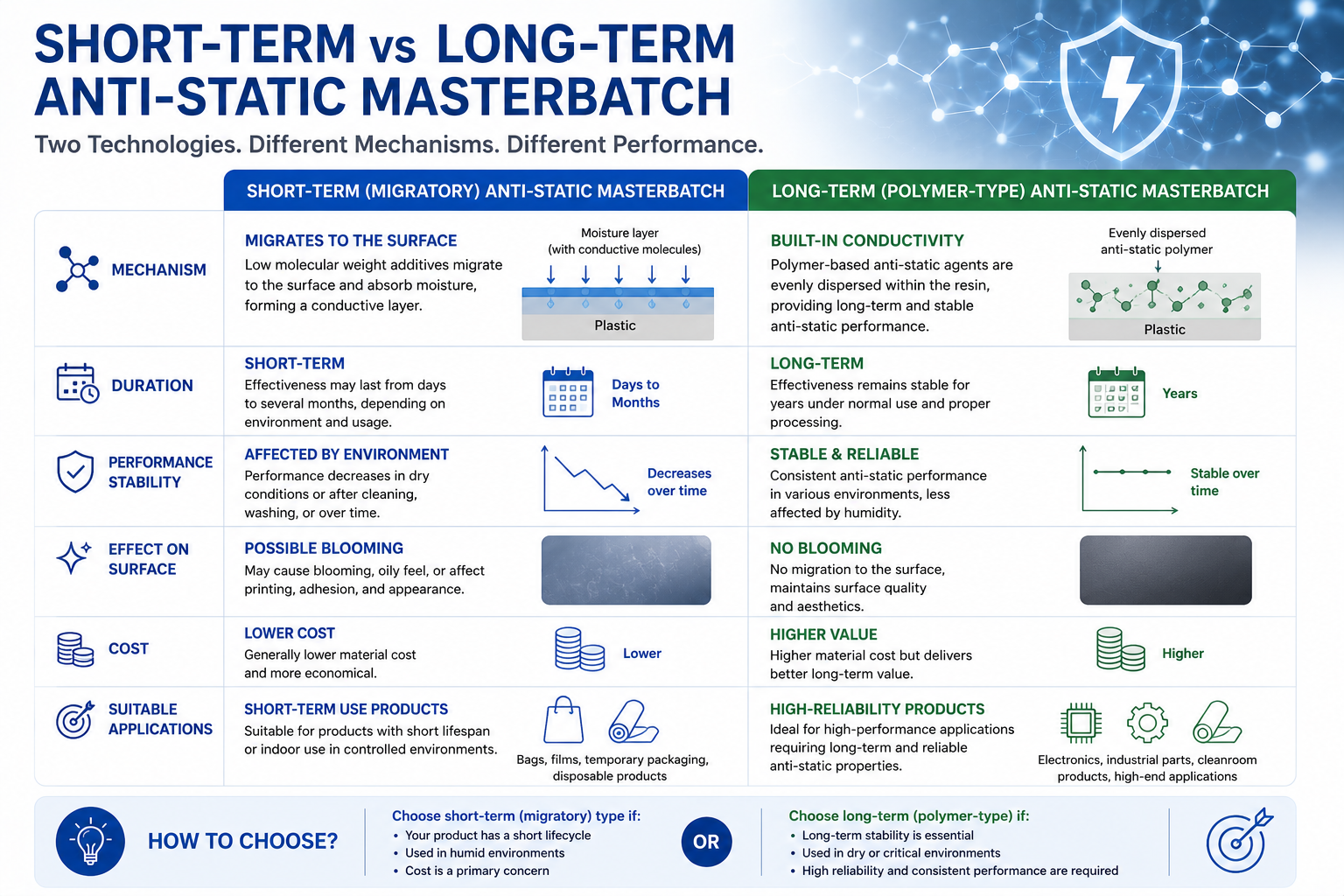
Short-term and long-term anti-static systems differ in mechanism, duration, environmental sensitivity, surface behavior, cost and suitable applications.
| Comparison Item | Short-Term Migratory Type | Long-Term Polymer Type |
|---|---|---|
| Mechanism | Additive migrates to the surface and supports charge dissipation | Functional material is dispersed within the plastic matrix |
| Performance Duration | Short to medium term; affected by storage and use | Designed for longer and more stable performance |
| Humidity Sensitivity | Generally more dependent on environmental moisture | Less dependent on ambient humidity |
| Cleaning Resistance | May decline after washing or wiping | Generally more resistant to repeated cleaning |
| Surface Effect | May bloom or affect adhesion and appearance | Lower tendency to migrate to the surface |
| Cost | Usually lower | Usually higher |
| Typical Applications | Films, bags, short-life packaging and disposable products | Electronics, industrial parts, cleanroom products and reusable items |
Chapter 8 | What Factors Affect Anti-Static Performance?
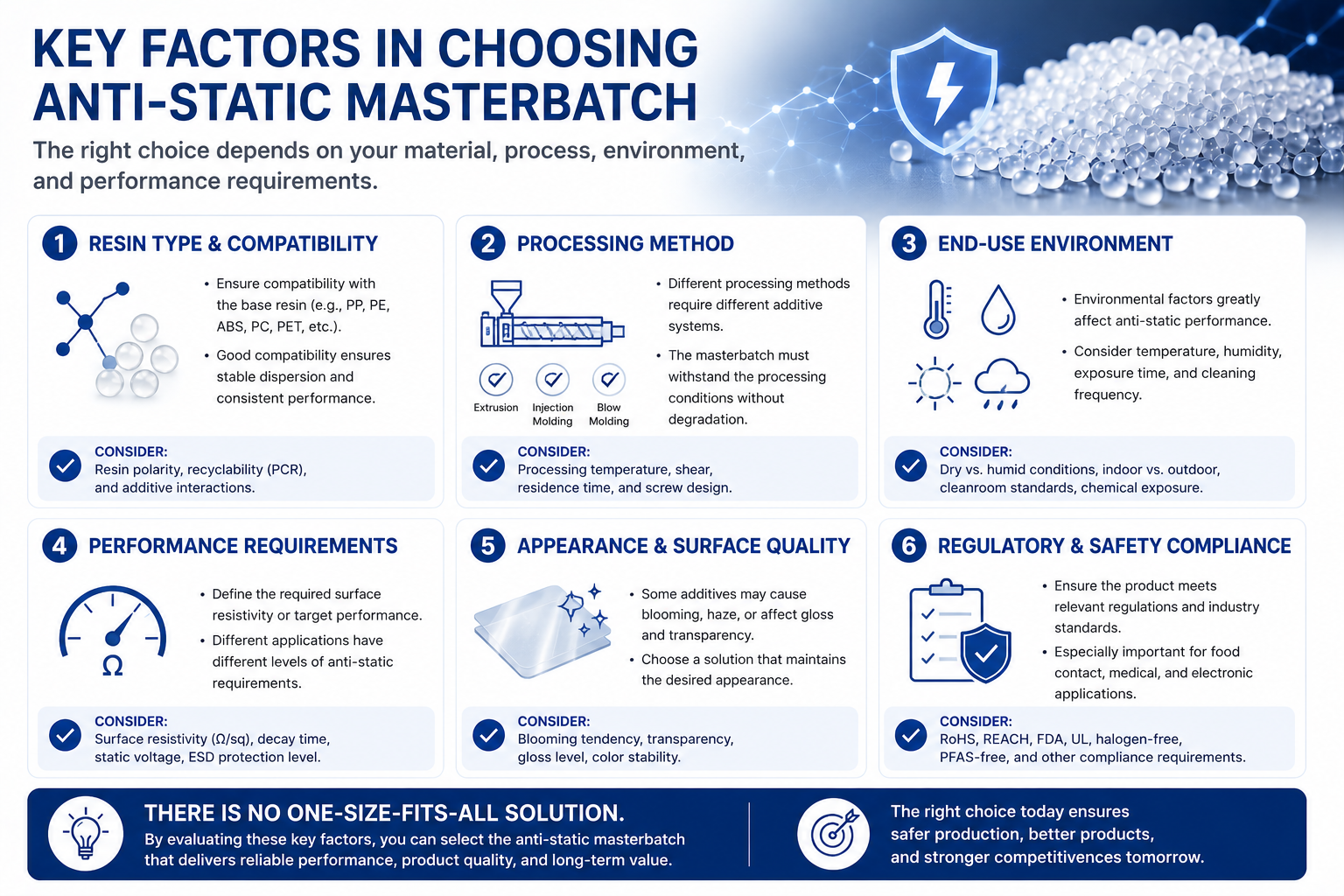
The final performance of an anti-static product depends on more than the masterbatch itself.
Resin Type
PE, PP, ABS, HIPS, PS, PC and other polymers have different polarity, processing temperatures and surface characteristics. Compatibility must be evaluated for each resin.
Product Thickness
Thin film, thick sheet and molded parts may require different formulations or addition levels because material distribution and charge behavior differ.
Use Environment
Temperature, humidity, dust, outdoor exposure, cleanroom conditions and cleaning frequency can all influence static accumulation and dissipation.
Processing Conditions
Melt temperature, shear, residence time, screw configuration, dispersion and molding conditions may affect final consistency.
Product Design
Surface area, geometry, texture and contact with other materials can change where and how quickly charge accumulates.
Chapter 9 | What Is the Difference Between Anti-Static, ESD and Conductive?
Anti-Static
Anti-static materials are designed to reduce charge accumulation and help prevent dust attraction, film sticking and processing disruption.
ESD
ESD stands for electrostatic discharge. ESD protection focuses on reducing the risk that a sudden discharge will damage sensitive electronic components during manufacturing, handling or transportation.
Conductive
Conductive materials provide a higher level of electrical charge transport. In addition to static control, they may be used in sensing, grounding, EMI shielding or other electrical applications.
These terms should not be treated as interchangeable. The correct material must be selected according to the customer specification, target resistance range and test method.
Chapter 10 | How Is Anti-Static Performance Evaluated?
Anti-static performance cannot be confirmed by visual inspection alone. Standardized test conditions are required for meaningful comparison.
Common Evaluation Items
- Surface resistivity or volume resistivity
- Static decay performance
- Static voltage
- Dust attraction
- Processing stability
- Appearance and transparency
- Mechanical properties
- Durability after storage, cleaning or repeated use
Why Must Testing Conditions Be Controlled?
Temperature, relative humidity, sample size, conditioning time, electrode configuration and test equipment may all affect the result. Samples should therefore be compared under the same conditions and according to the relevant customer or industry requirement.
Chapter 11 | Anti-Static Design Is Part of Product Development
Anti-static masterbatch is only one element of the final product. Resin selection, product geometry, processing method, use environment and other functional additives should be evaluated together.
The Application Determines the Design Direction
Electronic packaging may prioritize ESD protection, food packaging may focus on cleanliness and dust reduction, while automated equipment may require stable feeding and handling.
Multi-Functional Materials Are Increasingly Common
Products may need anti-static performance together with UV resistance, flame retardancy, antimicrobial properties, weather resistance or wear resistance. Interactions between additives must be tested.
Early Planning Reduces Development Risk
Confirming performance targets, processing conditions and validation methods early can reduce repeated formulation changes and shorten development time.
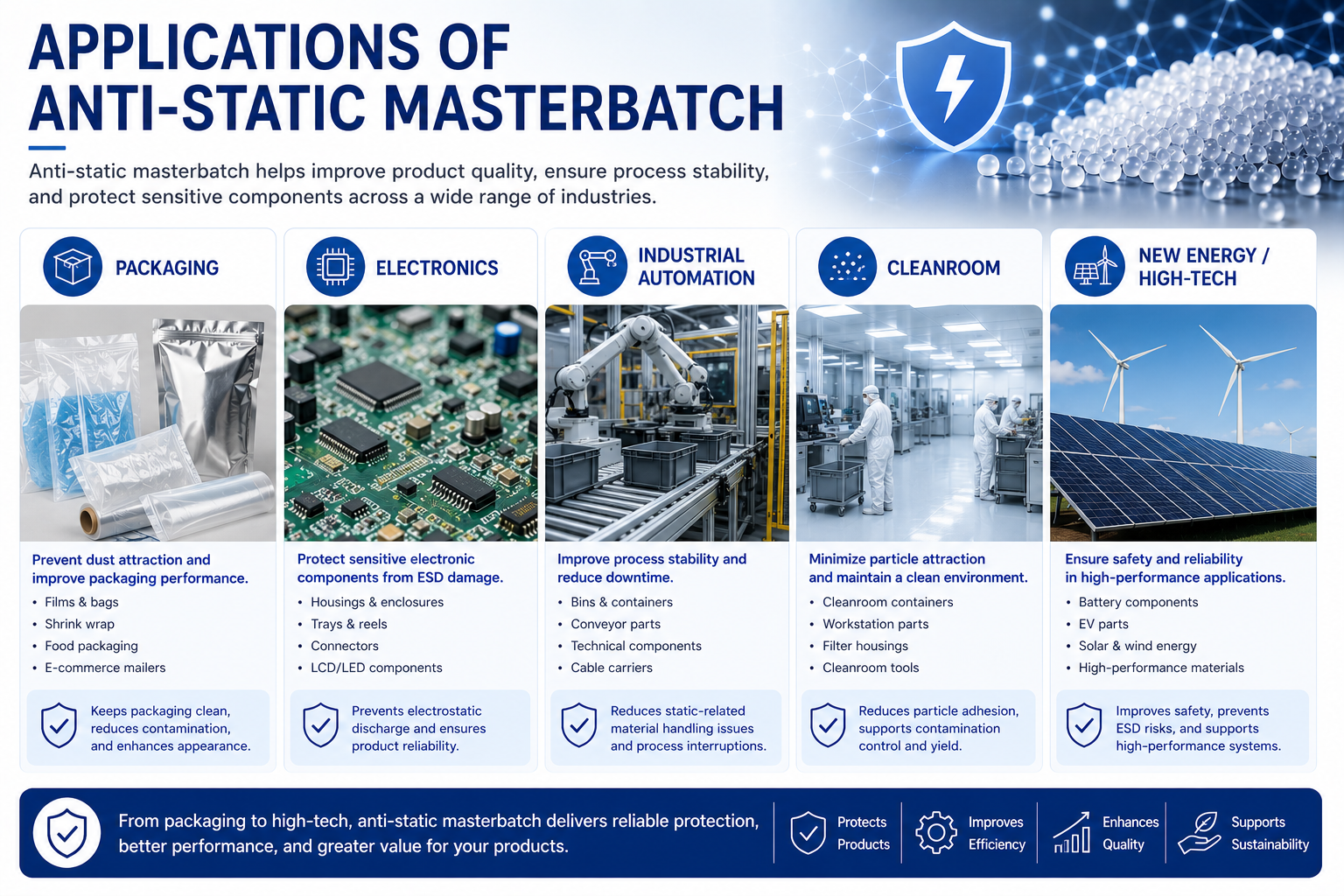
Chapter 12 | Applications of Anti-Static Masterbatch
Packaging: films, bags, shrink wrap, protective packaging and food packaging.
Electronics: IC trays, reels, connectors, housings and precision components.
Industrial Automation: bins, conveyor parts, fixtures, containers and equipment components.
Cleanrooms: cleanroom containers, workstation parts, filter housings, tools and consumables.
New Energy and High-Tech: battery components, EV parts, semiconductor equipment and high-performance electronic products.
Chapter 13 | Development Trends in Anti-Static Materials
Functional Integration
Future formulations are increasingly expected to combine anti-static performance with UV resistance, flame retardancy, antimicrobial properties or other functions.
Sustainable Materials
The growing use of PCR plastics, bio-based polymers and circular materials creates new compatibility and consistency challenges for functional masterbatch.
High-Precision Manufacturing
Semiconductor, electronics, medical and automation industries require tighter control of electrical, dimensional and processing performance.
Customized Material Development
More product developers are working with material suppliers at an early stage to align resin, process, performance targets and validation methods.
Chapter 14 | Frequently Asked Questions
Q1: Which plastics can use anti-static masterbatch?
Common base resins include PE, PP, ABS, HIPS, PS and PC. Compatibility and processing conditions should be confirmed for each application.
Q2: Can anti-static masterbatch affect product appearance?
Yes. Formulation and addition level may affect transparency, gloss, color or surface condition. Trial production is recommended.
Q3: Can anti-static masterbatch be combined with other functional additives?
Yes, but interactions with UV stabilizers, flame retardants, antimicrobial additives, pigments and fillers should be evaluated.
Q4: Should the finished product be tested?
Yes. Final testing confirms whether the molded product meets the required electrical, mechanical and appearance specifications.
Q5: Does every plastic product need anti-static performance?
No. The need depends on processing problems, use environment, product sensitivity and customer requirements.
Q6: How should I choose between short-term and long-term types?
Short-term migratory types are often suitable for short-life, cost-sensitive products. Long-term polymer types are more appropriate for durable, washable, dry-environment or high-reliability applications.
Conclusion | Start with the Real Product Requirement
The value of anti-static masterbatch is not simply a lower resistance reading. Its purpose is to improve product quality, processing stability and reliability throughout manufacturing and use.
The most suitable solution should be selected by considering the resin, process, environment, service life, appearance, regulatory requirements and target performance as one integrated system.
At KCI Master, we view functional materials as part of product development. Through material technology and application experience, we support customers in developing plastic solutions that balance quality, processing efficiency and long-term reliability.