
What Is Biochar Masterbatch? Benefits & Plastic Applications | KCI
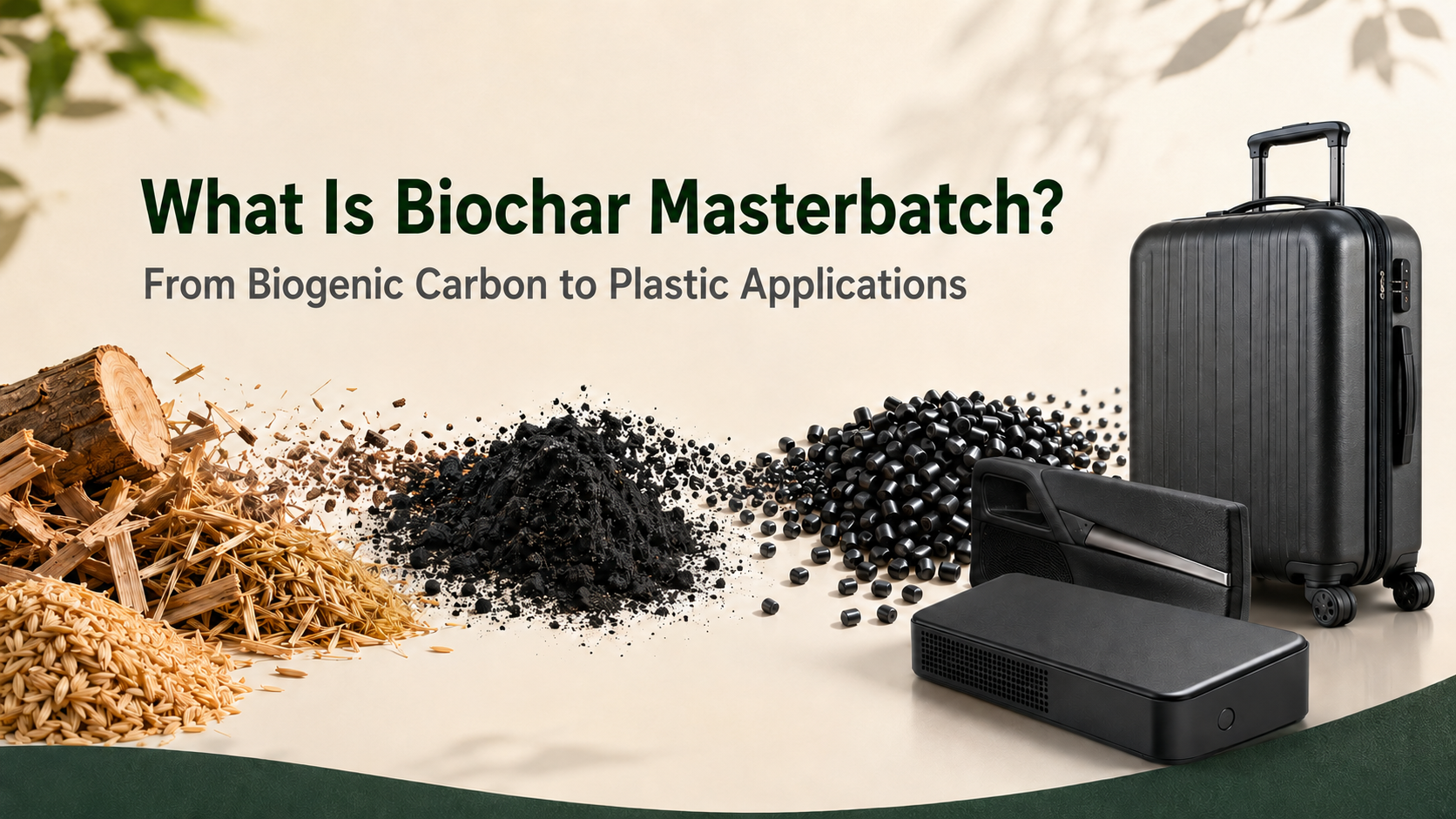
Biochar masterbatch introduces biogenic carbon into plastic materials, providing manufacturers with a material option that brings together processing feasibility, product design, and sustainability value.
As global net-zero strategies, product carbon footprint requirements, and supply chain carbon management continue to evolve, the plastics industry is looking beyond increasing recycled content and improving energy efficiency. Manufacturers are also exploring new material solutions with the potential to reduce dependence on fossil-based resources.
Biochar Masterbatch is one of these emerging solutions. It is not simply black powder added to plastic, nor is it just another type of black masterbatch. Its development requires careful consideration of biochar selection, pretreatment, dispersion, carrier resin design, formulation, and processing tests.
However, the carbon storage potential of biochar does not mean that every plastic product containing biochar can automatically be described as low-carbon or carbon-negative. Its actual environmental performance must be evaluated based on feedstock origin, formulation, manufacturing conditions, transportation, and life-cycle accounting.
What Is Biochar?
Biochar generally refers to a carbon-rich material produced by heating biomass in an oxygen-limited or low-oxygen environment through a process known as pyrolysis.
Common biomass sources may include:
- Agricultural residues
- Forestry residues
- Wood-processing by-products
- Rice husks, nut shells, and other plant-based by-products
- Other traceable biomass materials suitable for the intended application
Not all biochar has the same properties. Feedstock type, pyrolysis temperature, residence time, production equipment, and post-treatment methods can affect its carbon content, particle size, pore structure, ash content, moisture level, surface properties, and processing behavior.
For this reason, not every biochar material is suitable for direct use in plastics. Its source, quality specifications, intended use, safety requirements, and compatibility with the polymer system must be evaluated before application.
Why Does Biochar Have Carbon Storage Potential?
Plants absorb carbon dioxide from the atmosphere as they grow and store part of that carbon in biomass. When biomass naturally decomposes or is burned, part of the stored carbon is gradually returned to the atmosphere.
When biomass is converted into biochar under appropriate pyrolysis conditions, a portion of its biogenic carbon can form a relatively stable carbon structure. This can reduce the likelihood of that carbon returning to the atmosphere over a short period.
When biochar is incorporated into resins, plastics, or other durable materials, it may extend the time that biogenic carbon remains stored within a material system. This is one reason biochar has attracted attention in carbon management and sustainable material development.
The carbon storage potential of biochar is not a fixed value. Actual results depend on the biomass source, pyrolysis conditions, energy use, transportation, downstream processing, final application, and carbon accounting methodology.
Carbon Storage Does Not Automatically Make a Product Carbon-Negative
Determining whether a plastic product has a lower carbon footprint requires more than confirming that it contains biochar. The evaluation should also consider:
- The origin and production method of the biochar
- The carbon content and stability of the biochar
- The percentage of biochar and carrier resin in the formulation
- The carbon footprint of the base polymer
- Energy used during plastic processing
- Transportation distances
- Product lifespan and end-of-life scenario
- The system boundary and methodology used for carbon accounting
A more accurate description is that biochar masterbatch provides a material design option for introducing biogenic carbon into plastic products while evaluating opportunities to reduce dependence on fossil-based materials and lower the product carbon footprint.
What Is Biochar Masterbatch?
Biochar masterbatch is produced by dispersing appropriately treated biochar into a polymer carrier.
Raw biochar powder may present challenges such as inconsistent particle size, agglomeration, moisture, airborne dust, difficult dosing, and limited compatibility with certain resin systems. Pretreatment, particle-size control, formulation design, and masterbatch production can improve its handling in plastic processing environments.
What Are the Advantages of the Masterbatch Form?
- Reduces airborne powder and handling difficulties
- Improves dosing and addition-rate control
- Supports more consistent dispersion in the polymer
- Reduces the risk of uneven raw material mixing
- Helps establish more consistent processing conditions
- Allows the carrier resin and formulation to be adjusted for different applications
Masterbatch production does not automatically eliminate every processing challenge. Biochar may still affect melt flow, viscosity, surface appearance, color, and mechanical properties. Application-specific sampling and processing tests are therefore required before commercial introduction.
Why Is the Plastics Industry Paying Attention to Biochar Masterbatch?
Plastic material selection has traditionally focused on cost, color, processing efficiency, and product performance. As brands and supply chains place greater emphasis on product carbon footprints, raw material sources, and circular design, sustainability information is becoming an increasingly important part of product development.
Biochar masterbatch connects biogenic carbon with established plastic processing systems. This allows companies to evaluate opportunities to reduce the use of fossil-based materials, extend the storage of biogenic carbon, and develop products with more clearly documented sustainability characteristics.
Biochar masterbatch should not be treated as a simple environmental label. It is a material engineering solution that requires a balance among raw materials, formulation, processing, performance, appearance, cost, and verifiable carbon information.
Key Benefits of Biochar Masterbatch
1. Potential for Lower-Carbon Material Design
By selecting an appropriate biochar source and adjusting the addition rate according to product requirements, manufacturers can introduce biogenic carbon into plastic material systems and potentially reduce the use of certain fossil-based materials.
Whether the final product achieves a lower carbon footprint still depends on the base resin, biochar source, formulation, manufacturing energy, transportation, and product life cycle.
2. Support for Sustainable Product Development and Material Data Management
When information about feedstock origin, formulation, processing, and carbon emissions is available, biochar masterbatch may support the evaluation of:
- Sustainable product development
- Green procurement and material selection
- Product carbon footprint assessments
- Supply chain carbon data management
- Material information for sustainability reporting
- Responsible sustainability communication
The use of biochar masterbatch does not by itself create a verified ESG or carbon reduction result. Any claim included in an ESG report, carbon footprint declaration, or corporate reduction target should follow the applicable accounting and verification requirements.
3. Improved Handling Compared with Raw Powder
Compared with the direct use of raw biochar powder, proper pretreatment, carrier selection, and masterbatch design can improve dosing, dispersion, and handling during plastic processing.
Actual processing behavior will still depend on the base polymer, biochar properties, addition rate, equipment, and processing conditions. Testing is required to establish appropriate operating parameters.
4. Application-Specific Formulation Design
KCI can evaluate and adjust the following according to the customer’s application requirements:
- Biochar feedstock and source
- Carrier resin system
- Biochar addition rate
- Dispersion and processing behavior
- Color and surface appearance
- Product performance requirements
- Processing equipment and conditions
- Material traceability and sustainability data requirements
The goal of formulation design is not simply to maximize the amount of biochar. It is to find the right balance among sustainability, performance, appearance, processing requirements, and cost.
Where Can Biochar Masterbatch Be Used?
Biochar generally gives plastic materials a black, dark, or low-saturation appearance. It is therefore particularly suitable for products that accept darker colors and place value on durability, material identity, and sustainable design.
Travel Goods and Durable Products
- Luggage shells
- Storage products
- Outdoor products
- Reusable durable products
Consumer Electronics and Equipment Housings
- Electronic device housings
- Electrical components
- Black or low-saturation appearance parts
- Nontransparent plastic housings
Automotive and Transportation Applications
- Automotive interior components
- Decorative exterior components
- Nonstructural plastic components
- Low-carbon material concept parts
Building Materials and Industrial Applications
- Plastic sheets and panels
- Plastic pipes
- Injection-molded and extruded products
- Industrial plastic components
Packaging and Reusable Products
- Industrial packaging
- Transportation packaging
- Reusable containers
- Durable packaging products
The applications listed above represent areas that may be evaluated. They do not indicate that every product has completed commercial production validation. Processing, mechanical, weathering, safety, and regulatory tests should be conducted according to the intended use.
Which Plastic Materials Can Be Evaluated?
Biochar masterbatch can be designed with different carriers and formulations for evaluation in several plastic material systems, including:
- PP — Polypropylene
- PE — Polyethylene
- ABS — Acrylonitrile Butadiene Styrene
- PS — Polystyrene
- Other thermoplastic material systems
Different polymers have different polarity, processing temperatures, melt-flow behavior, and performance requirements. A single biochar masterbatch formulation should not be assumed to work in every material system.
Suitability must be confirmed based on the base polymer, biochar properties, addition rate, processing equipment, product structure, and required performance.
Global Trend: Growing Demand for Lower-Carbon Material Information
Global policies and market expectations are encouraging companies to pay greater attention to material sourcing, product carbon footprints, and supply chain emissions data. Relevant developments include:
- The European Green Deal and circular economy policies
- Brand-level carbon reduction and sustainable procurement commitments
- Product carbon footprint and life-cycle assessment requirements
- Supply chain carbon data and sustainability disclosure requirements
- CBAM and carbon-cost requirements affecting specific industries
The European Union’s Carbon Border Adjustment Mechanism currently applies primarily to specific carbon-intensive goods listed in the relevant regulations. It does not directly cover every plastic material or plastic product.
However, the broader supply chain carbon management trend reflected by CBAM is encouraging more brands and manufacturers to request information about material origin, emissions factors, and product environmental performance.
KCI Biochar Masterbatch Solutions
KCI Biochar Masterbatch development focuses on biochar pretreatment, carrier resin selection, dispersion design, and masterbatch production. The objective is to help customers evaluate the feasibility of introducing biochar into plastic products.
KCI Development Capabilities
- Biochar feedstock and carrier resin evaluation
- Biochar pretreatment and dispersion design
- Masterbatch production to reduce powder-handling difficulties
- Formulation adjustment based on polymer and processing method
- Balancing appearance, addition rate, and product performance
- Sampling and processing support
- Commercial production feasibility evaluation
- Material sourcing and sustainability information support
From material selection and formulation design to sampling, testing, and production feasibility evaluation, KCI works with customers to introduce biochar into practical plastic product development.
Biochar Masterbatch FAQ
Q1: Can Biochar Masterbatch Completely Replace Plastic?
No. Biochar masterbatch is used as one component within a plastic material system. It must still be combined with an appropriate carrier resin and base polymer and cannot completely replace the plastic matrix.
Q2: Which Plastics Can Be Used with Biochar Masterbatch?
Formulations may be evaluated for PP, PE, ABS, PS, and other thermoplastic systems. Because each polymer has different processing temperatures, polarity, and performance requirements, application-specific testing is required.
Q3: Can Biochar Masterbatch Affect Plastic Processing?
Yes. Biochar may affect melt flow, viscosity, moisture sensitivity, dispersion, surface appearance, and mechanical properties.
Proper pretreatment, carrier selection, and masterbatch design can improve dosing, dispersion, and powder handling. However, testing is still required to determine suitable addition rates and processing conditions.
Q4: Will Biochar Masterbatch Affect Product Color?
Yes. Biochar normally has a black or dark appearance and may affect the color, brightness, and opacity of the final product. It is generally better suited for black, dark, or low-saturation applications.
KCI can evaluate color performance, biochar content, and formulation options according to product requirements.
Q5: Does Biochar Always Improve Material Performance?
Not necessarily. Its effect on stiffness, impact resistance, dimensional stability, and other properties depends on the biochar source, particle size, dispersion, polymer type, and addition rate. Performance must be confirmed through testing.
Q6: Does Using Biochar Masterbatch Automatically Make a Product Carbon-Negative?
No. A low-carbon or carbon-negative claim requires a broader assessment of the biochar source, carbon content, addition rate, base polymer footprint, manufacturing energy, transportation, product lifespan, and end-of-life scenario.
The result should be determined through an appropriate carbon accounting methodology and, when required, independent verification.
Q7: If the Biochar Feedstock Is EBC- or WBC-Certified, Are the Masterbatch and Final Product Automatically Certified?
Not necessarily. Certification normally applies to a defined producer, production process, material, application category, and traceability scope.
The use of certified upstream biochar does not automatically grant the same certification to the downstream masterbatch or finished plastic product. Projects with certification requirements should confirm the certificate holder, certificate number, validity period, application category, and chain-of-custody requirements.
Conclusion: Moving Biochar from Carbon Material to Practical Plastic Applications
The value of biochar masterbatch is not simply the addition of biochar to plastic. Its value comes from material selection, pretreatment, dispersion, masterbatch production, and processing tests that allow biochar to be introduced into polymer systems in a more controlled and practical way.
Biochar masterbatch offers manufacturers an opportunity to introduce biogenic carbon into products, reduce dependence on certain fossil-based materials, and explore more sustainable material designs.
However, environmental performance and product properties must be supported by traceable feedstock information, appropriate formulation design, and actual test results.
If you are evaluating biochar masterbatch, PCR composite materials, durable product housings, or other lower-carbon plastic applications, KCI MASTER can support your project from material evaluation and formulation design to sampling, processing tests, and commercial production feasibility assessment.
References
-
International Biochar Initiative: What Is Biochar?
-
European Biochar Certificate: Official Information
-
EBC Carbon Sink Certification
-
European Union: Carbon Border Adjustment Mechanism Regulation
This article is provided for general material and application reference. Product performance, carbon footprint, environmental claims, and certification eligibility must be evaluated according to the feedstock documentation, formulation, processing conditions, test reports, and applicable standards for each project.