
Quality Is Not the Final Check, It Is Built in Every Step | Masterbatch Quality Control
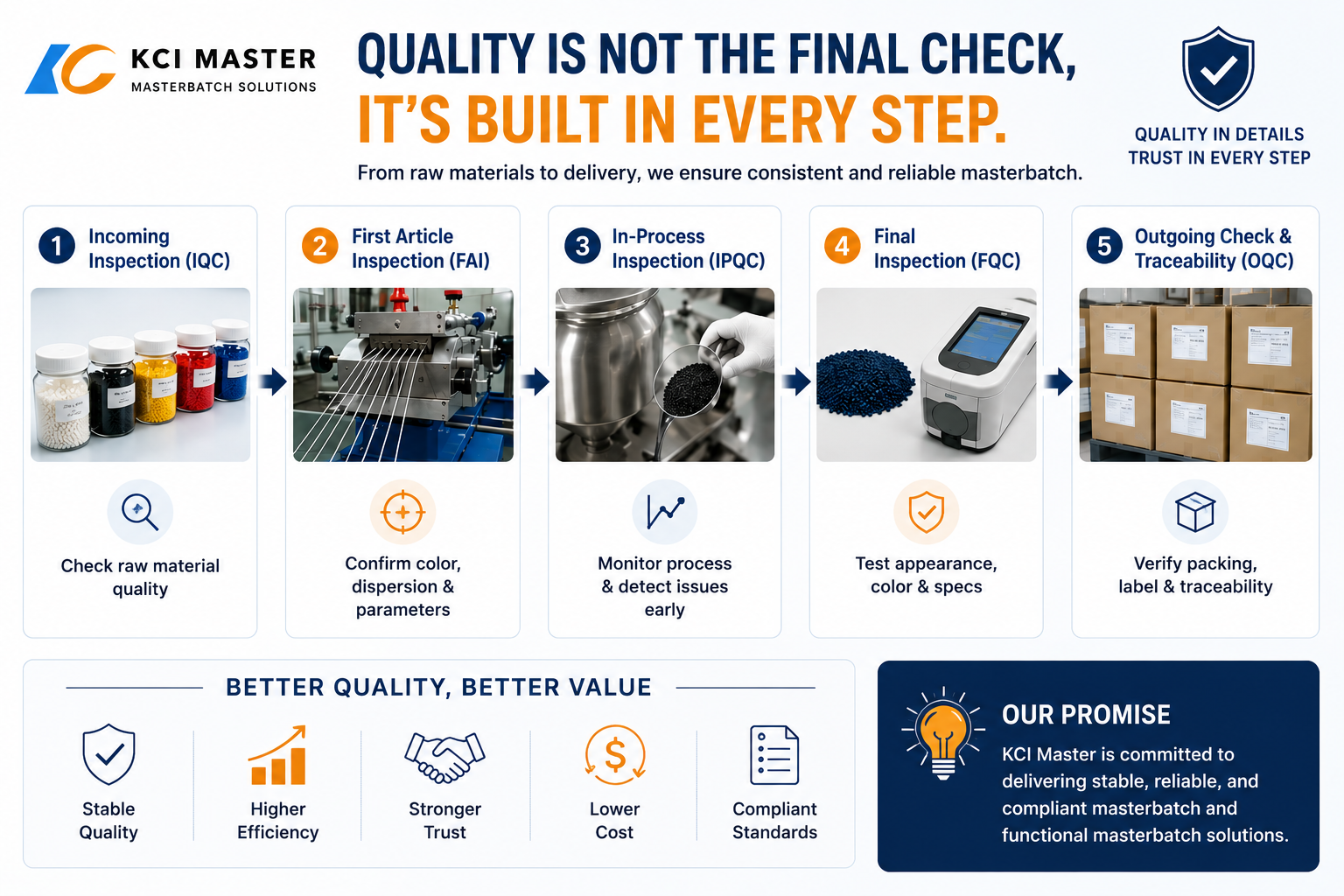
Quality Is Not the Final Check, It Is Built in Every Step
How Masterbatch Quality Control Helps Reduce Product Risks
When people talk about product quality, final inspection is often the first thing that comes to mind.
However, in real manufacturing, quality is not simply checked at the end. It is built throughout raw material control, production, inspection, packaging, and delivery.
Quality is not created by the final check. It is built in every step of the process.
Why Final Inspection Alone Is Not Enough
If color deviation, poor dispersion, or specification issues are only found after a batch of masterbatch has been fully produced, the problem has already reached the final stage.
At that point, raw materials, machine time, labor, and production costs may have already been consumed. If the issue is discovered at the customer end, it may lead to returns, production delays, complaints, and loss of trust.
That is why mature quality management does not rely only on final inspection. It builds quality control points throughout the entire process.
The Core of Quality Management: Multiple Quality Control Points
In color masterbatch and functional masterbatch production, quality control is not a single action. It is a continuous process.
Each control point helps detect potential issues early, reduce risks, and maintain stable quality across different production batches.
Step 1: Incoming Inspection (IQC)
Quality control starts with raw materials.
Even when raw materials appear to meet the same specification, different batches may vary due to manufacturing conditions, transportation, storage, or supply sources.
Incoming inspection may include:
- Raw material appearance
- Specification confirmation
- Moisture and basic properties
- Compliance with purchasing requirements
- Suitability for specific applications
If raw materials are unstable from the beginning, even a well-controlled production process may still be affected.
Step 2: First Article Inspection (FAI)
After production equipment is set up, mass production does not usually start immediately.
The first article is checked to confirm whether color, dispersion, appearance, processing conditions, and production parameters are correct.
The purpose of first article inspection is to confirm the right direction before full production begins. If deviation is found early, the process can be adjusted before it becomes a full-batch issue.
Step 3: In-Process Inspection (IPQC)
After mass production begins, quality control continues.
During production, raw material conditions, equipment temperature, screw shear, environmental humidity, and operating conditions may all affect product stability.
In-process inspection helps monitor color, dispersion, appearance, and key process conditions during production.
Its value is to detect abnormal trends early instead of waiting until the entire batch is completed.
Step 4: Final Inspection (FQC)
After production is completed, final inspection confirms whether the product meets customer specifications and delivery requirements.
Depending on the product type and application, final inspection may include appearance checks, color difference testing, dispersion confirmation, melt flow testing, packaging inspection, label verification, batch number confirmation, and customer-specific requirements.
Final inspection is an important gate before delivery, but it should not be the only quality control step.
Step 5: Outgoing Check and Traceability (OQC & Traceability)
Before shipment, packaging, labels, quantity, and batch numbers should be verified.
A complete traceability system can record raw material sources, production date, equipment, batch number, inspection results, and retained samples.
When future quality analysis or issue tracking is needed, complete records help shorten investigation time and support continuous improvement.
Handling Quality Issues: Finding the Root Cause Matters
Every manufacturing facility may experience quality issues.
Mature quality management is not about blaming people first. It is about understanding how the issue happened and how to prevent it from happening again.
When an issue occurs, key questions may include:
- Did the raw material meet the specification?
- Was the formulation suitable for the application?
- Did the process conditions change?
- Did the equipment require maintenance or calibration?
- Was the operating procedure followed correctly?
- Could the inspection process detect the issue earlier?
The goal is not only to solve the current issue, but also to establish improvement actions that prevent recurrence.
Quality Improvement Is a Continuous Cycle
Quality management is not a one-time task. It is a continuous improvement cycle.
Every issue, process adjustment, and customer feedback can become an opportunity to improve the quality system.
- Identify the issue
- Control the risk temporarily
- Analyze the root cause
- Develop improvement actions
- Verify the improvement results
- Standardize the process to prevent recurrence
Through this cycle, quality management can move from passive inspection to active prevention.
How KCI Master Approaches Quality Management
At KCI Master, we believe quality comes from every detail, not only from the final inspection.
During color masterbatch and functional masterbatch development, we start by understanding product application, base resin, processing method, use environment, regulatory requirements, and functional needs.
Throughout production and quality control, we apply multiple quality checkpoints, including incoming inspection, first article inspection, in-process inspection, final inspection, outgoing check, traceability, and retained sample management.
Our goal is to reduce product risks and help customers build more stable and reliable plastic products.
FAQ
Q1: Does passing final inspection mean the product has no quality risk?
Not always. Final inspection usually confirms product quality based on sampling results. Long-term quality stability still depends on raw material control, process control, and traceability.
Q2: Why does masterbatch production need in-process inspection?
Because masterbatch production may be affected by raw material batches, equipment temperature, shear conditions, and environmental factors. In-process inspection helps detect deviations early.
Q3: What do IQC, IPQC, FQC, and OQC mean?
IQC means Incoming Quality Control. IPQC means In-Process Quality Control. FQC means Final Quality Control. OQC means Outgoing Quality Control. Together, they form a complete quality management process.
Q4: What is traceability?
Traceability means recording key information from raw materials, production, inspection, and shipment, so future quality analysis and issue tracking can be performed efficiently.
Q5: Is quality control only about finding defective products?
No. The main goal of quality control is to prevent problems, reduce risks, maintain batch consistency, and support reliable long-term product performance.
Recommended Reading
To learn more about material selection, masterbatch quality, and plastic product development, we also recommend:
- Why the Same Color Masterbatch Cannot Be Used for Every Product: The Importance of Material Selection
- What Is Masterbatch? Types, Benefits, and Applications
- How to Choose the Right Color Masterbatch for Plastic Products
- What Is Functional Masterbatch? Applications and Selection Guide
Conclusion
Quality is not just an inspection report, and it is not only the final step before shipment.
Stable quality comes from material selection, raw material control, process management, inspection systems, and traceability working together.
When every step carries quality awareness, products can maintain stable performance across different batches, environments, and applications.
Quality is not checked only at the end. It is built step by step throughout the process.
If you are looking for stable color masterbatch, functional masterbatch, or plastic material solutions, KCI Master can support you from material selection to quality management and help you build more reliable products.