
Moisture Management Masterbatch: Building Long-Lasting Quick-Dry Performance into the Fiber
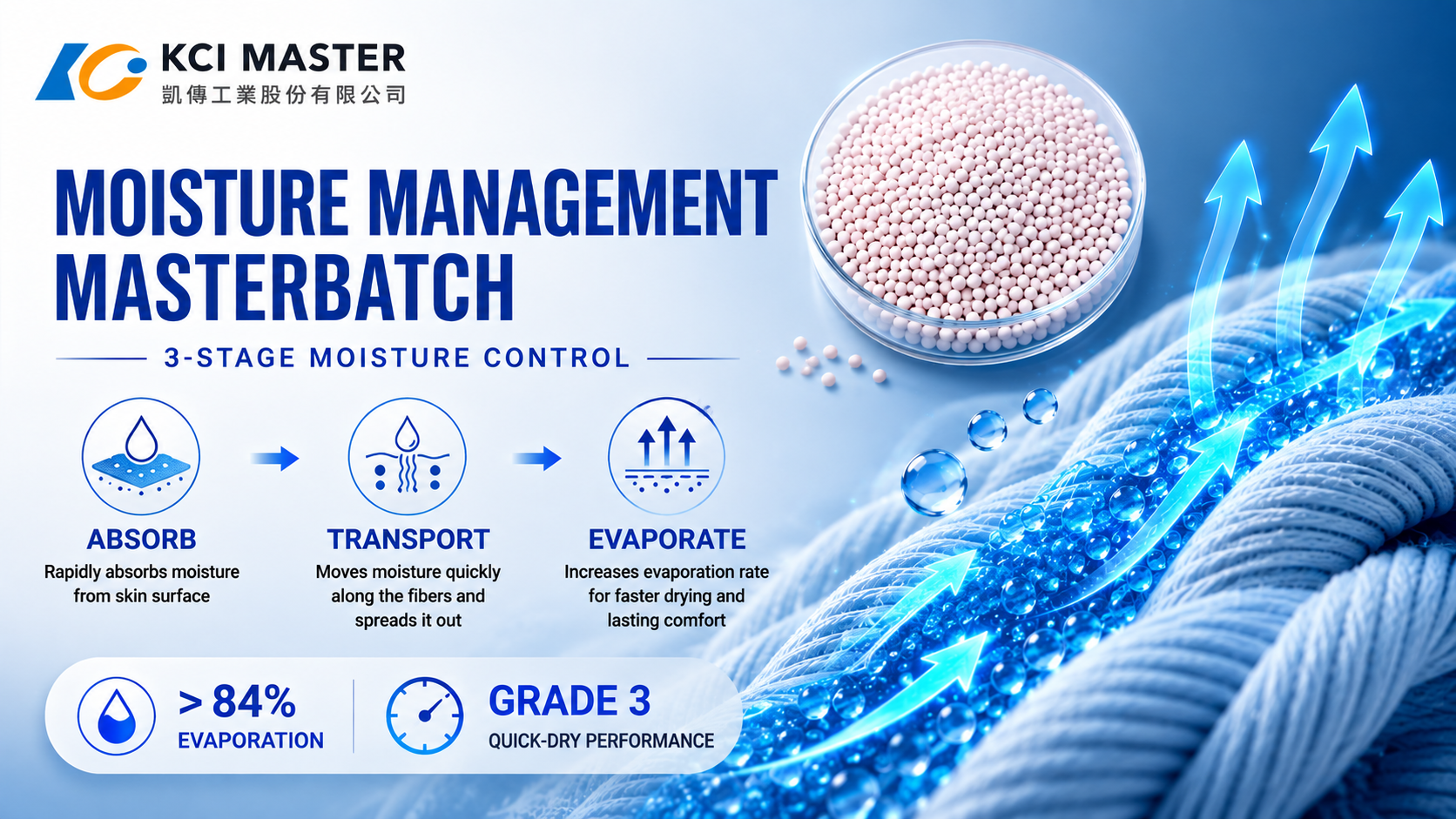
In sportswear, outdoor apparel, and garments worn in hot environments, comfort depends on more than how much moisture a fabric can absorb. What matters is how efficiently moisture can move away from the skin, spread across the fabric, and evaporate.
If sweat is absorbed but remains concentrated in one area, the fabric may still feel wet, sticky, and uncomfortable.
This is why modern performance textiles increasingly focus on moisture management rather than absorption alone. Effective moisture management creates a continuous pathway that moves moisture from the skin-contact area through the fabric and eventually into the surrounding air.
KCI Moisture Management Masterbatch approaches quick-dry performance from the material level. The functionality is incorporated into the fiber material system itself, providing a third development route beyond engineered cross-sectional fibers and topical finishing treatments.
How Do Quick-Dry Textiles Work? Three Common Technology Routes
Not all moisture-wicking or quick-dry textiles achieve their performance in the same way. Depending on where and how the functionality is introduced, three major approaches can be considered.
Approach 1|Engineered Cross-Section Fibers: Using Physical Structure to Move Moisture
Conventional synthetic fibers commonly have a near-round cross section. Engineered fibers, by contrast, may use cross-shaped, Y-shaped, multi-lobed, or grooved profiles.
These geometries create small channels that help move liquid through capillary action, allowing moisture to travel along and between fibers.
Engineered cross-sectional fibers are an established solution for performance textiles, but product development may require consideration of:
- Specialized fiber geometry
- Corresponding spinneret designs
- Adjusted spinning conditions
- Process stability
- Fiber and fabric construction
For production lines already designed around conventional round fibers, introducing a specialized cross section may therefore require additional evaluation of equipment, processing conditions, and production stability.
Approach 2|Topical Finishing: Adding Moisture Management after the Fabric Is Made
A second common approach is to apply a finishing treatment after the fiber or fabric has already been produced.
Hydrophilic finishing agents or other surface treatments can improve wetting, moisture spreading, and quick-dry behavior without redesigning the fiber itself. This makes finishing highly flexible for existing textile products.
However, because much of the functionality is applied to the fiber or fabric surface, repeated laundering, friction, detergents, and normal use may gradually reduce the performance of some topical treatments.
The actual wash durability depends on the chemistry, fixation method, processing conditions, and laundering environment. For products designed for repeated washing and long-term use, durability therefore becomes an important development consideration.
Approach 3|Moisture Management Masterbatch: Integrating Functionality into the Fiber Material
KCI follows a third technology route.
Instead of relying on a complex fiber shape or applying functionality after the fabric is finished, moisture-management functionality is introduced before the fiber is formed.
KCI Moisture Management Masterbatch integrates quick-dry functionality directly into the fiber matrix, making moisture management part of the material system itself.
This approach provides another option for textile development by reducing dependence on complex cross-sectional profiles and topical chemical finishing, while addressing some of the processing and durability considerations associated with the first two approaches.
Instead of asking only “What shape should the fiber have?” or “What treatment should be added afterward?”, material design allows us to ask a different question: “How can moisture management be built into the fiber from the beginning?”
Moisture Management without Complex Cross-Sectional Profiles
One important feature of KCI Moisture Management Masterbatch is that it can support moisture-management development without requiring complex engineered cross-sectional fibers.
By introducing functionality through the material formulation, the technology can be developed with conventional round cross-section fibers.
For textile manufacturers, this means quick-dry performance does not have to depend entirely on specialized fiber geometry. The material formulation itself can also become part of the moisture-management design.
KCI’s Three-Stage Moisture Management Mechanism
The core of KCI Moisture Management Masterbatch is not simply “absorbing water.” The objective is to create a continuous moisture-management process.
1. Rapid Absorption
When moisture reaches the fiber, the material promotes rapid wetting and helps move liquid away from the original point of contact.
Purpose: Quickly take up moisture and reduce the amount of sweat remaining concentrated near the skin-contact area.
2. Liquid Transport
After initial absorption, moisture spreads along the fibers and across a larger area of the fabric.
A wider distribution helps reduce localized wetness while increasing the effective surface area exposed to air.
Purpose: Transport and spread moisture efficiently across the textile structure.
3. Accelerated Evaporation
Once moisture is distributed over a larger surface area, greater exposure to air can support faster evaporation.
Purpose: Reduce moisture residence time and help the fabric return to a drier, more comfortable state.
Rapid Absorption
→
Liquid Transport
→
Accelerated Evaporation
Together, these three stages form a complete moisture-management mechanism rather than evaluating quick-dry performance based on water absorption alone.
Test Performance: More than 84% Moisture Evaporation
Performance materials should be evaluated with measured results, not only with descriptions such as “quick-dry,” “dry comfort,” or “moisture wicking.”
According to KCI’s current standardized test results, the material achieved more than 84% moisture evaporation and reached Grade 3 quick-dry performance.
The results demonstrate the ability of the material-based moisture-management system to support the complete process from initial absorption and moisture transport to evaporation.
Actual performance may vary depending on formulation, addition level, spinning conditions, fabric construction, and test conditions. Final product performance should be verified through application-specific testing.
Why Does Wash Durability Matter in Performance Textiles?
The value of a performance textile should not exist only when the product is new.
When functionality relies mainly on a topical finishing treatment, repeated washing and abrasion may gradually reduce the performance of certain surface-applied systems.
KCI Moisture Management Masterbatch introduces the functionality during material processing and fiber formation instead of relying solely on a post-applied surface treatment.
This shifts the development question from “Does the product perform when it is new?” to “Can the functionality remain effective through actual use and repeated laundering?”
This durability perspective is increasingly important as functional textiles move from short-term performance claims toward long-term product value.
How Do the Three Moisture-Management Approaches Compare?
| Technology | Source of Function | Key Characteristic | Development Consideration |
|---|---|---|---|
| Engineered Cross-Section Fiber | Physical fiber geometry | Uses capillary action to support moisture transport | Fiber profile, spinneret design, and process conditions |
| Topical Finishing | Fiber or fabric surface | Adds functionality after textile production | Performance retention after repeated laundering |
| Moisture Management Masterbatch | Fiber material system | Builds moisture management into the material | Formulation, addition level, and spinning conditions |
Each technology has suitable applications and manufacturing conditions. There is no single approach that is automatically the best choice for every textile product.
KCI Moisture Management Masterbatch offers another development option: rather than relying entirely on specialized fiber geometry or surface finishing, moisture-management functionality can be designed into the fiber material itself.
From Masterbatch to Functional Fabric
KCI Moisture Management Masterbatch can be introduced at the raw-material stage of the spinning process:
Moisture Management Masterbatch
↓
Conventional Round Cross-Section Fiber
↓
Functional Fabric
↓
Performance Apparel & Textile Products
This material-level approach allows functionality to be considered before the final textile product is formed rather than being added only after the fabric is completed.
Applications of Moisture Management Masterbatch
Moisture Management Masterbatch is suitable for textile products that remain in close contact with the body, are exposed to perspiration, or require a drier and more comfortable user experience, including:
- Performance sportswear
- Outdoor apparel
- Casual functional apparel
- Functional underwear
- Polo shirts and workwear
- Yoga and fitness apparel
- Home textiles
- Bedding products
From high-intensity exercise to everyday use, the objective of moisture management remains the same: reduce prolonged moisture retention and support a drier, more comfortable textile experience.
KCI Master: Designing Function from the Material Level
The next step in functional textiles is not simply adding more performance claims. It is reconsidering a more fundamental question: Where should functionality begin?
Engineered cross sections begin with fiber geometry. Finishing treatments begin at the textile surface. Functional masterbatch begins with the material itself.
KCI Master continues to develop functional masterbatch technologies that integrate color, performance, and material design into polymer systems, helping customers develop solutions based on their spinning conditions and end-use requirements.
For moisture management, the goal is not simply to “absorb faster.” It is to create a complete process:
Rapid Absorption
↓
Liquid Transport
↓
Accelerated Evaporation
From raw material to finished product, functionality is built in from the start.
BEYOND COLOR, DESIGNED FOR THE FUTURE.
FAQ|Moisture Management Masterbatch
What is the difference between Moisture Management Masterbatch and a moisture-wicking finishing treatment?
The main difference is where the functionality is introduced. A finishing treatment is applied to the fiber or fabric surface after textile production, while Moisture Management Masterbatch is incorporated during material processing and fiber formation so the functionality is built into the fiber material system.
Do quick-dry textiles always require engineered cross-section fibers?
No. Engineered cross-section fibers use geometry and capillary action to support moisture transport. KCI Moisture Management Masterbatch takes a material-formulation approach and can be developed with conventional round cross-section fibers.
Why can the performance of some moisture-wicking finishes decrease over time?
Some finishing systems rely primarily on functionality applied to the fiber or fabric surface. Repeated laundering, friction, and detergent exposure may therefore gradually reduce their performance. Actual durability depends on the finishing chemistry, fixation method, processing conditions, and washing environment.
What test performance has KCI Moisture Management Masterbatch achieved?
According to KCI’s current standardized test results, the material achieved more than 84% moisture evaporation and Grade 3 quick-dry performance. Final performance should be confirmed according to the actual formulation, fiber, fabric construction, processing conditions, and test method.
Does better moisture management simply mean absorbing more water?
No. For performance textiles, effective moisture management depends on how efficiently moisture is absorbed, transported, spread, and evaporated. A textile that absorbs a large amount of water but retains it for a long time may still feel wet and uncomfortable.